
By Tadzio Mueller; originally published in German on the blog Peaceful Sabotage. Republished with permission.
Tadzio Mueller has been sharing extracts on his blog, in German, from the unedited draft of his next book, titled Together Against Fear: Solidarity-Based Collapse Politics. He has kindly given me permission to republish his extracts on COTW in English. Below I have included some of his introduction to the extract originally published on his blog on the 2nd of July 2026, with the extract following the intro:
…What you have before you here is the actual ending of the book; these will be the final pages, paragraphs, and sentences. The first draft isn’t finished yet; I’ve missed all sorts of deadlines and still have a lot to revise and rewrite (including this final section). But I think I’ve got the gist of it.
Take a look at the ending and let me know if you get the same impression. Oh, and this time I’m not really asking for critical feedback – I’d be happy to give that next week. Today I just want to celebrate having come this far in two months of writing. 220 pages, 7 chapters, a story that I hope you’ll find interesting.
So here it is, as a teaser and for the “hey Tadzio, that sounds really good” fishing for compliments: the conclusion of my second book. Together Against Fear: Solidarity-Based Collapse Politics, to be published in October 2026 by Mandelbaum Verlag.
Enjoy.
*******
Don’t go gentle into that good night.
Rage, rage against the dying of the light.
Dylan Thomas
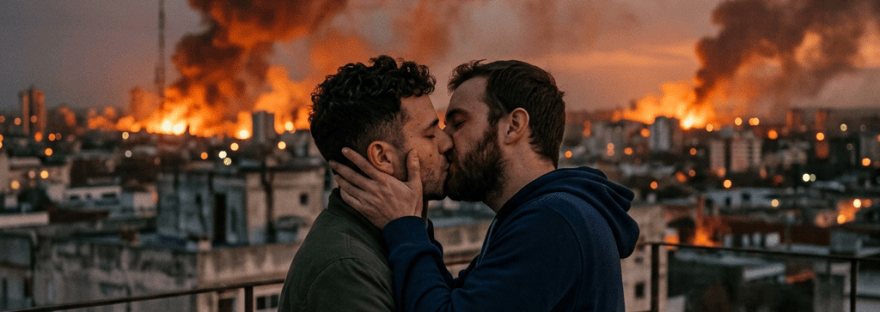
The last gay kiss
…Now, in a left-wing political book, this would usually be the point where the “ visioning ” section begins, because every grand left-wing narrative—and this book would at least like to be one—needs a utopia, because without utopia there is no “utopian warmth.” Without utopia, the political perspective I have presented here wouldn’t necessarily differ from that of an average volunteer fire department somewhere in the middle of Germany. When I explained the “SoliPreppen” strategy to an old friend and comrade a good two years ago, he asked me, somewhat smugly, whether “shoveling sandbags in the flood” had really become the sole horizon of my political thought and action—and if so, whether I, as a communist, wasn’t ashamed of that.
Of course, it was mostly friendly banter at first, but the question stuck with me; I quoted it in almost every reading and public event because it preoccupied me for a long time: what exactly is the “radical” core of my narrative? Does it even have one?
What has always distinguished the “radical” left from the “moderate” left—I deliberately avoid using historically specific labels like “revolutionary” or “reformist,” firstly because they are too imprecise, and secondly because, as explained above, the term “revolutionary” no longer has any meaning and therefore cannot function as the counterpart in a pair of concepts—was utopia. In concrete workers’ struggles, for example, social democrats and communists get along well; both wanted wage increases. But for social democratic workers, wage struggles were truly about wages, whereas struggles within capitalism, for example, about the relative distribution of surplus value between the two competing and mutually dependent classes, could only ever be a step towards better organization for the revolution for communist workers: utopia, that is, assumptions about the future, determine the meaning of things in the present.
Which means that without a vision of the future, the present isn’t entirely meaningless in a political sense, but if I’m sitting in the present, wondering what to do tomorrow, the only way to make that decision meaningfully is to have some idea of what the day after tomorrow will look like. Strategies are lines, and to keep these lines from going all over the place , they need a vanishing point. Traditionally, for the radical left, this vanishing point is “the revolution.” Later, when it became clear to most thinking leftists that the Leninist revolution had become about as realistic as the idea of a cavalry squadron winning a naval battle, we called it “transformation,” which really just meant “a whole lot of reforms that will eventually become a revolution”—in essence, nothing at all.
There is essentially no radical-left utopia left, apart from the modernist fever dreams of the “accelerationists,” whose strategic position was summarized in * Empire *—a book widely received within the anti-globalization movement and representing the central theoretical framework of the radical left in imperial centers during the 2000s—as follows: ” We’ve got to push through *Empire* and come out the side .” In other words: capitalism to the limit, then a magical transition to communism, and everyone’s happy. Fully automated luxury communism as the last false utopia of capitalist modernity.
But there is no longer a progressive bourgeois utopia either, because at its core, it would always have resembled the world of Star Trek/“Starship Enterprise”: democracy everywhere, technological hyper-progress everywhere, no wars, no poverty… in the bourgeois utopia, it’s simply that everyone has become a citizen, because the way our lives (and now I mean specifically: my class) ideally look – prosperous, peaceful, endowed with rights and political power – is what all lives should be able to look like, right? This idea is now just as realistic as the Leninist revolution, or indeed the victory of Kublai Khan’s cavalry in the Peloponnesian War. The long-observed “brutalization” of the bourgeoisie – which I analyzed in my last book as “assholeization” – is also a reaction to the repressed realization of the impossibility of everyone in the world living like the bourgeoisie in, for example, Germany, and therefore the bourgeoisie also feels that its privileges will not necessarily last. It’s possible that someone else, sometime, might do to us what we, of course, used to do to others, elsewhere: defeat militarily, occupy, rob, kill. That this isn’t particularly realistic is a given. But perpetrators of violence are themselves so traumatized by their own acts of violence that they are never again able to look at the victims of their crimes and aren’t afraid that they, too, will one day suffer the same fate they inflicted on others.
It is clear that there can be no ecological, no green utopia in a global ecological collapse. But left-wing and bourgeois, humanist utopias also cease to function in a collapse. The collapse sweeps away the vanishing points of modern capitalist politics, including the left , because these were always high on the Y-axis of societal outcomes: ” the arc of the moral universe is long, but it bends towards justice .” Since only net negative societal outcomes are conceivable in a global ecological collapse—because the material conditions of human life on the planet will change so rapidly and so drastically that “chaos” is the most likely macro result—new vanishing points, new progressive utopias, are needed.
Border utopias in collapse
But can utopias even exist in a collapse? A brief look back: ever since Thomas More wrote the first “utopia” in the early 16th century, the utopia (simultaneously a “non-place,” and the “happy place”) has been a non-existent place, outside of reality, from which one can criticize reality. Everything that is bad in reality is good at the utopia (the non-place), and remains good. The utopia is a stable place of goodness, if not perfection, and collapse is precisely what makes all places unstable . No matter where you live, the more ecological collapse escalates, the faster it has effects on Earth, the fewer stable places there will be. That’s why the super-rich are building so many spaceships: because they’ve understood this.
Okay, so if there can be no true utopia in the classical sense, do we really need one? I mean , I’ve been resisting every bit of “hopium” in the climate and collapse debate, and I get incredibly annoyed when my comrades try to sneak magical thinking into our strategy discussions through some back door – do I really want to be the one who brings utopia back into the collapse debate?
The answer will surprise you: yes, that’s who I want to be. My experience during my “future depression,” that phase of utter meaninglessness in my life when there was no escape except ” get high and get fucked ,” showed me that I can’t function without an “escape route.” I need the idea of a goal that lies outside the present, a situation I can work towards, a ” horizon state ,” something that can never be reached, but in which direction one can always move.
The concept of “direction” is also emphasized by what is probably the most famous formulation of the function of “utopia” in the history of the global left. The Uruguayan author Eduardo Galeano once wrote this: “Utopia stands on the horizon. I take two steps toward it, it recedes two steps. I take ten steps and the horizon retreats ten steps. What is the purpose of utopia? To enable us to move forward.”
Moving forward. That’s precisely what I’m talking about: that we move forward, keep going, keep fighting, keep loving, keep going… That’s why I still need utopia. But utopia in the classical sense is impossible in a collapse, because, as I said: a utopia is a stable place from which we can criticize the existing order, but since in a collapse “stable places” are not only “far away” but actually impossible , we have to adapt the concept to the collapse. If there can be no stable places from which we can criticize the existing order, and which can represent our strategic points of escape, then we need a conception of “utopia” that is not static, that can always and everywhere work, regardless of how good or bad the situation is in which we act. The “utopia” then doesn’t describe a perfect place we’re striving for, but rather an action, an intervention, intended to create a temporary state: it consists of an action working towards a goal; it’s a utopia that consciously focuses on “moving on,” no matter how bad things get in reality. Frankly, that sounds totally abstract, so I’d rather make it concrete and tell you about my very personal collapse utopia.
Important note: this will differ from your own collapse utopias. How exactly we imagine the collapse and our role in it is a totally personal matter, just like our fears – I’m terrified of my HIV medication running out, most of you probably aren’t, so different plans and strategies emerge, which makes perfect sense . My collapse utopia starts with me, with my fears, my needs, my abilities, which is why it might only motivate me – but that’s fine, because that’s precisely what it’s meant to do: motivate me, enable me to keep going. So I’m not necessarily inviting you to make my collapse utopia your own; it’s quite niche. Of course, I’m happy if it inspires you, but actually, by telling this last little story, I want to invite you to formulate your own collapse utopias. In my narrative, Nazis and communist queer people appear, as well as sex-positive parties in dark Berlin basements, fights, or shootouts with fascist combat troops. My own private utopia stems very much from my own imagination, and when someone once asked me if I couldn’t formulate a less “private” utopia, one potentially for everyone, for example, one that included children, my answer was: nope, my utopias are about fighting and kissing; children simply don’t fit into that. If you want children in your utopias, then include them. That’s what the collapse movement is about. Do it yourself. Because, firstly, your utopia is there for you; it’s meant to help you move forward: that’s much, much more efficient if you create it yourselves. And secondly, because the “collapse utopia” you formulate will always also be an answer to the question that also drives this search: who do I want to be, who will I be in the collapse—and of course, I have absolutely no idea what that looks like for you in concrete terms. And once we all have such a utopia in front of us, a path we can continue on, then it would be exciting to put them in relation to each other, for example within the framework of a solidarity-based collapse movement.
My own private collapse utopia
But we’re not there yet; there’s still a long way to go, through increasingly contested terrain that’s becoming ever more difficult to navigate. When I first became aware of this new terrain, I despaired because I couldn’t find a way through the thicket that loomed before me. And why should I even bother fighting my way through all that muck if defeat is the most likely outcome anyway, if the dangers are so great, if the other side is so strong? Why fight if we’re most likely going to lose ?
But then I realized that I don’t function as a human being unless I feel like I’m moving forward strategically, taking action. Finding a way through the thicket became a matter of survival for me— literally : I had tried to distance myself from “politics” and “the struggle,” and what I was and did during that time… well. I’ve had better days —and as we all know, in the service of our own survival, we often become quite creative.
This is how I see it now: while we are in a poor strategic situation compared to 10 or 20 years ago, others, elsewhere, were in far worse situations and still fought. There are many examples I could cite, and each carries its own risks: whether I cite indigenous struggles in the Americas, which have been undermined by Europeans for over 500 years, or the Warsaw Ghetto Uprising, which, despite its lack of success, enabled affirmative, fighting Jewish life in a hell designed to destroy Jewish life, I would always be citing struggles and situations significantly different from ours. I would always be in danger of drawing the wrong conclusions from the experiences of others, based on my own privileged position.
So I’ll try it without historical comparisons: the agenda isn’t all that complicated: No matter how bad things get, we don’t have the right to give up, and that also means we don’t have the right, as most of us still do, to escape into comfortable lies, into one of those hopium stories where China, Norway, or some enlightened aliens can still save us from ourselves. No matter how dramatically the situation deteriorates here at home, the classic queer strategy of “getting up, straightening our crowns, and fighting on…” applies.
Fight on until…? Until when and where? My collapse utopia begins, appropriately , in a dystopian situation, which might sound strange at first, but is functional in the context of collapse: if the future becomes dystopian, then the utopia that allows me to “keep going” in this future despite everything must also make sense in a dystopia, no matter how dark it is. Therefore, collapse utopias should always start with a “worst-case scenario” and locate something inspiring within it—something that motivates one to “keep going.”
In my mind, it looks like this: the global ecological collapse has, within just a few years, led to the violence, destruction, and social chaos that we previously exported now arriving in the wealthy, externalizing societies of the North. Fascism is armed; in most countries of the “old West,” it also controls the state apparatus; and Germany has once again become world champion. For the second time, we hold the trophy for “greatest fascist assholes of all time” in our hands; we are, as always, the biggest bastards.
Some cities withstood the attacks from the more rural regions for a while, but one after another they fell under the onslaught of the brown hordes (if you hear echoes of Lord of the Rings here: sure. We’re telling stories, aren’t we? ). All cities? No, Berlin, populated by indomitable migrants, queers, and communists, was the last city to hold out—until very recently, when the fascists surrounded the city, cut us off from our forward defense positions (formerly: “commuter belt”) and food production enclaves, and, with the support of collaborators in wealthy West Berlin and fascist Southeast Berlin, began to advance toward the Berlin Ring. The mythical “Last Battle”, the communist Ragnarök ( except that we traditionally hoped we’d win – the old Vikings were more realistic, they knew the good guys would lose in the end) is brewing on the Tempelhof Field, not because urban warfare spills into open field battles, but because my mind can stage it better there.
The final battle doesn’t interest me: I’m part of the Pink Panther Brigades, whose task is to organize—and, if necessary, fight for—temporary but safe spaces for queer life in the socio-ecological hellscape that the world, including its formerly wealthy parts, has become in collapse, where brown hordes have taken over almost all of Europe, where people perceived as migrants, leftists, queer people, and people with disabilities have to hide. We know defeat is coming. That’s precisely why we’re throwing all our remaining resources into our core mission: enabling and defending queer life. We’re retreating to the city’s catacombs, to the many cellars and tunnels beneath Berlin that we’ve developed and interconnected through years of proactive preparation.
Messages are going out to our allies beyond Berlin: the world’s major cities have fallen, but everywhere—remember Independence Day: the aliens destroy the cities, people retreat to caves, deserts, and forests—radical queers still live, and everywhere people want to throw one last awesome queer party before going into permanent exile, to a camp, or… as Rosa Luxemburg once put it: “I will still hopefully die at my post: in a street battle or in prison. “
The Pink Panthers’ final battle, therefore, is not the (in this dark utopia) hopeless fight on Tempelhof Field against the advancing masses. It is the fight in the catacombs for affirmative queer life, for queer life as it should be: free, ecstatic, communal, awesome, supportive, loving, sexy, euphoric, human… The party is a riotous celebration; there is no longer any distinction between the darkroom and the dance floor. Everywhere there is kissing, sex, eating, drinking, crying, dancing, bondage, whipping, love, and laughter…
I’m not at the party myself. I’m part of the Panthers; our job was to make the party possible, now it’s our job to defend it. I hear the music, I hear the groans and the laughter. I’m not there, and yet this moment fills me completely, because I know exactly what I’m doing, why I’m standing here: at one of the entrances to the catacombs, where I can already see the first vanguard of fascists advancing towards us. I know: the party won’t last much longer. The enemy is already here.
But I also know: the longer we stand here, the longer queer life will continue. So let’s throw everything into this final moment, truly sacrificing ourselves. For what has become the meaning of our lives in recent years. The defense of queer life, the active, the proactive creation of spaces where queer and feminist and humanistic and supportive and loving and warm… where human life is possible as it should be. The kind of life that so irritates the assholes, precisely because it is so human.
In my dystopian vision of collapse, I, we, are capable of defending this last queer party against the advancing fascists until the last sixteen-year-old on this planet has shared the last gay kiss with the last eighteen-year-old. And as strange as that may sound, that’s enough for me as a “meaning of life,” enough for me as a goal for a fulfilling life in the midst of collapse. And if that isn’t enough motivation to imagine the space of catastrophe as a strategic space, then I don’t know what is. Because the agenda is clear, the path is clear—we just have to pull ourselves together and start walking it.
To be sure : we can achieve and fight for far, far more in this catastrophe than simply making a gay kiss possible somewhere. But my point is this: this thought provides orientation. Everything good that we can fight for is important, because if we don’t fight for it, don’t create it, then this good won’t exist in a world that will otherwise only get worse.
With increasingly exhausted greetings,
Yours truly, Tadzio.



 Centre of the Web