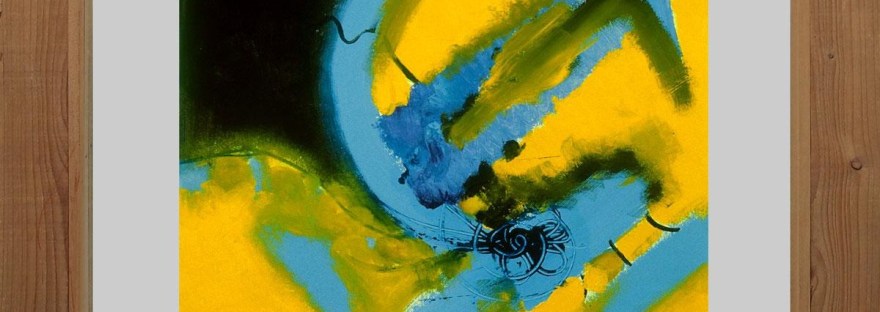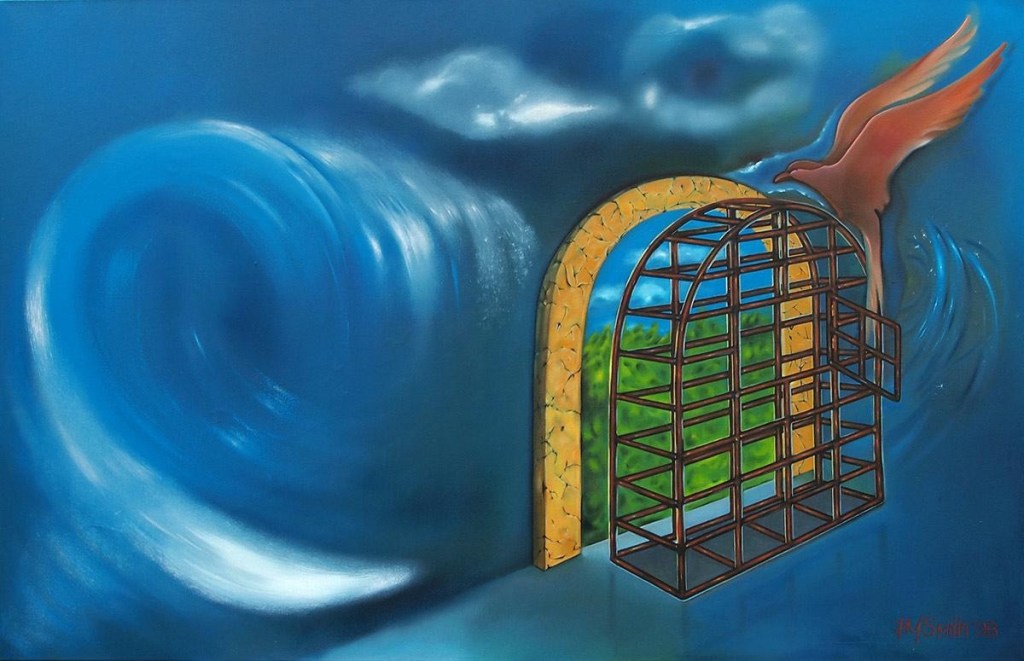
Featured image: ‘Aerial View’ 1996, acrylic on board
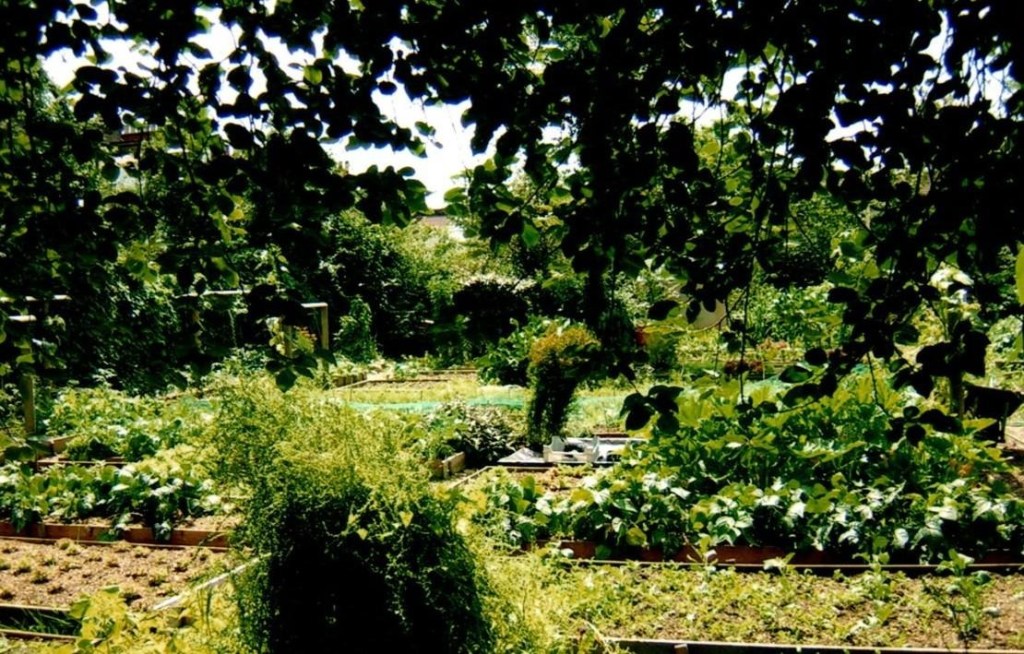
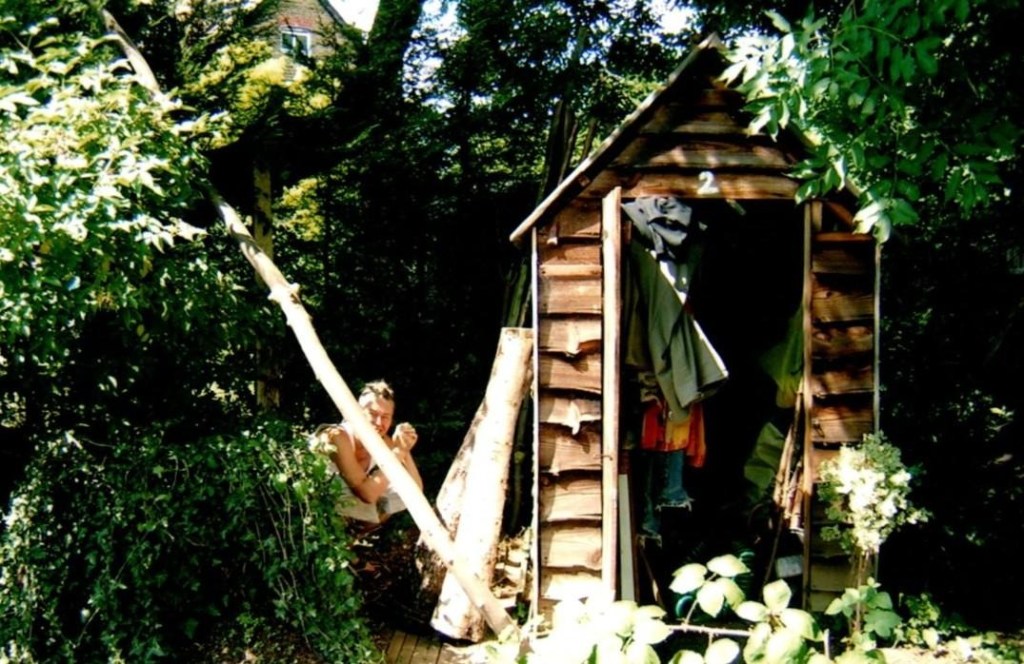
In 2000 I found a studio, housed within and named after an old Chocolate Factory, where the plan was to house 100 artists. It was a walk across the park from my flat and near to the allotment! I was creating my little natural world in London! I was the first artist in and my work became freer. I painted, sculpted, crafted, and made clothes, mostly from recycled materials.
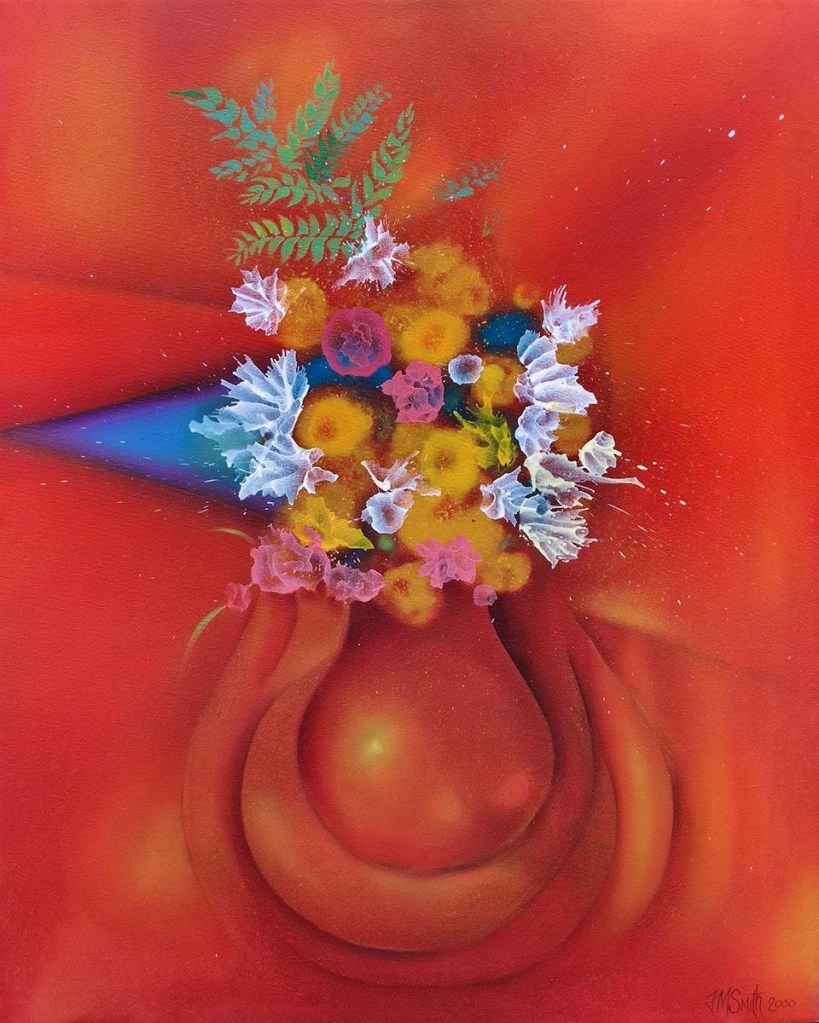
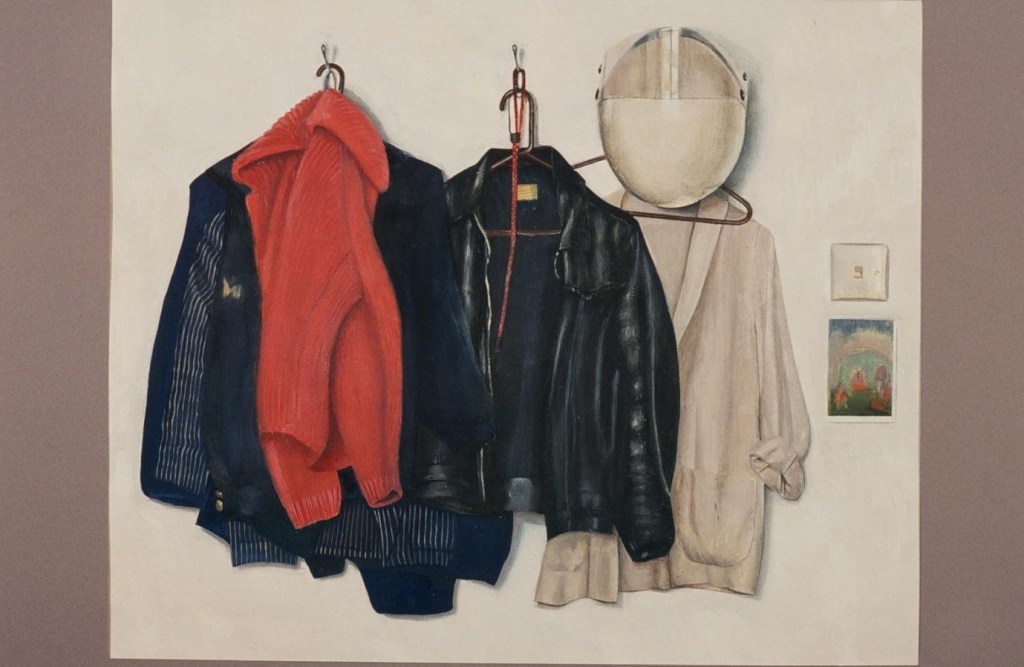
‘Red Still Life’ 2000, oil on canvas
I came across a leaflet for a residency at Dorland Mountain Arts colony in California, applied for it and was accepted. Somehow, I made the money to go and so I made drawings of an ambitious painting I wanted to do there. I tentatively bought a huge roll of canvas thinking that I could cut it down when I arrived if it was too big.
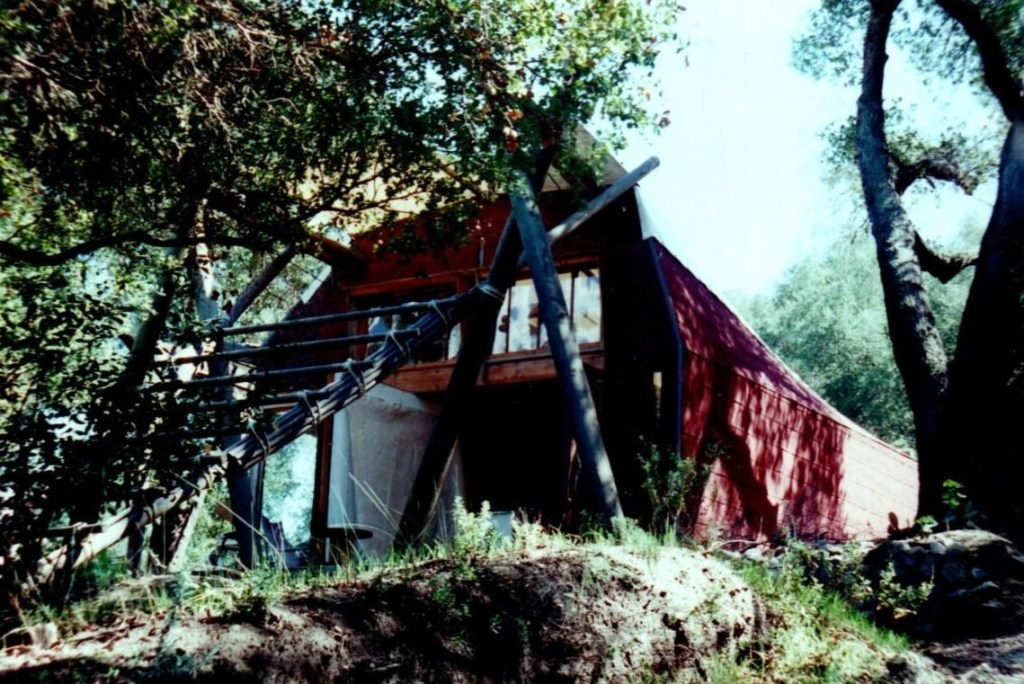
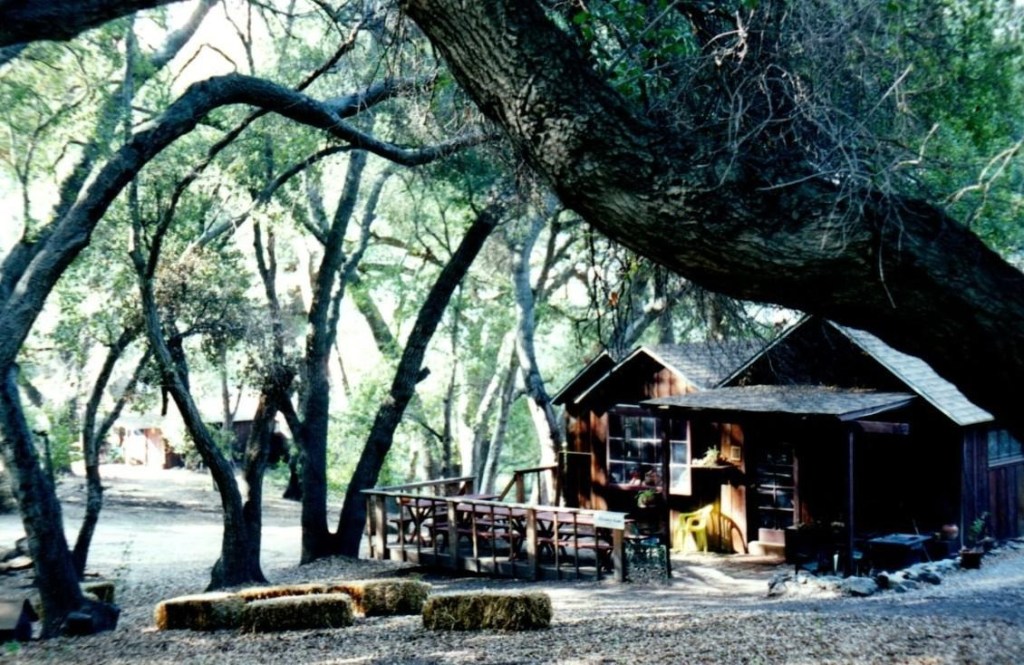
In March 2001 I arrived at Dorland and I was shown to where I would be staying for the next month. Wow! The Retreat was sensational. It sat nestled on a remote hillside with fabulous views all around. It was a massive building with a canvas roof and windows which showed the moon coming up at night. The wood burner was the only source of heating and I had never lit a fire in my life. I soon learned and became an expert.
The Retreat
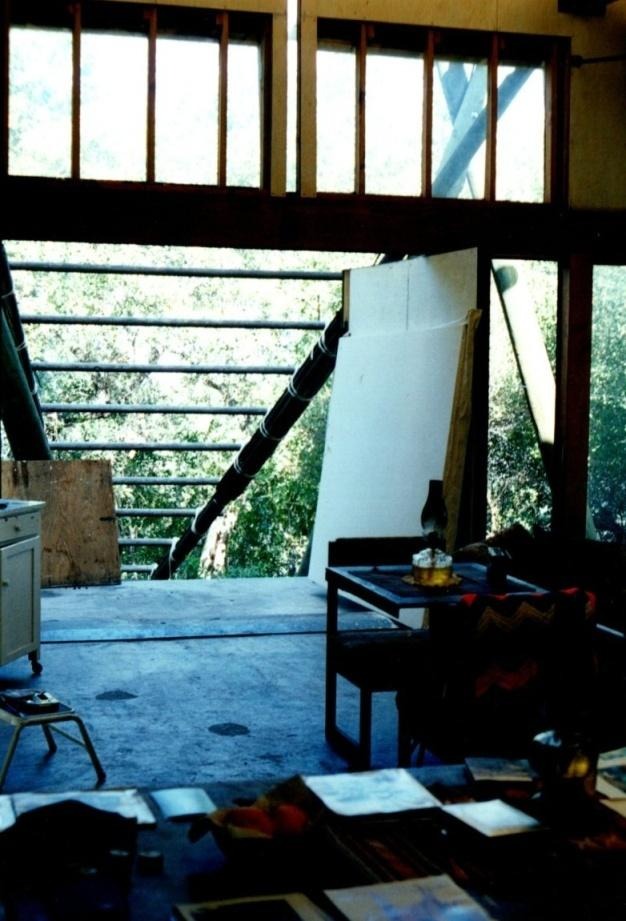
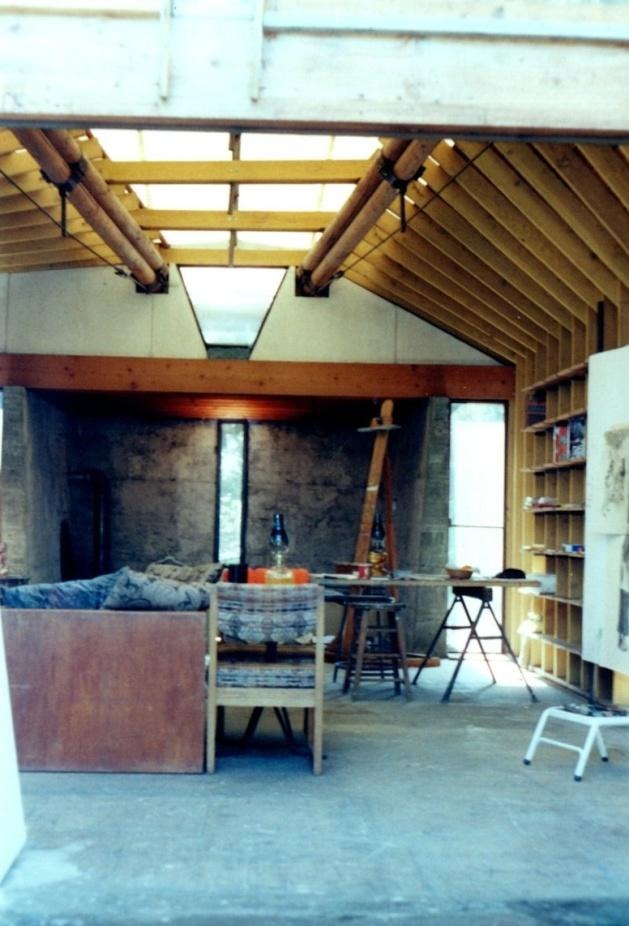
Robert, a permanent resident showed me inside the house and when he got back to the front door, he said “oh, and there is this…” He lifted a pole at the side of the front door and the whole front wooden wall opened out onto a concrete balcony. The amazing thing was, there was a massive drawing board attached to this wall and it was exactly the size of my canvas! Needless to say I didn’t cut it down and I spent the whole month painting outside.
Front wall, living space, and communal dining room
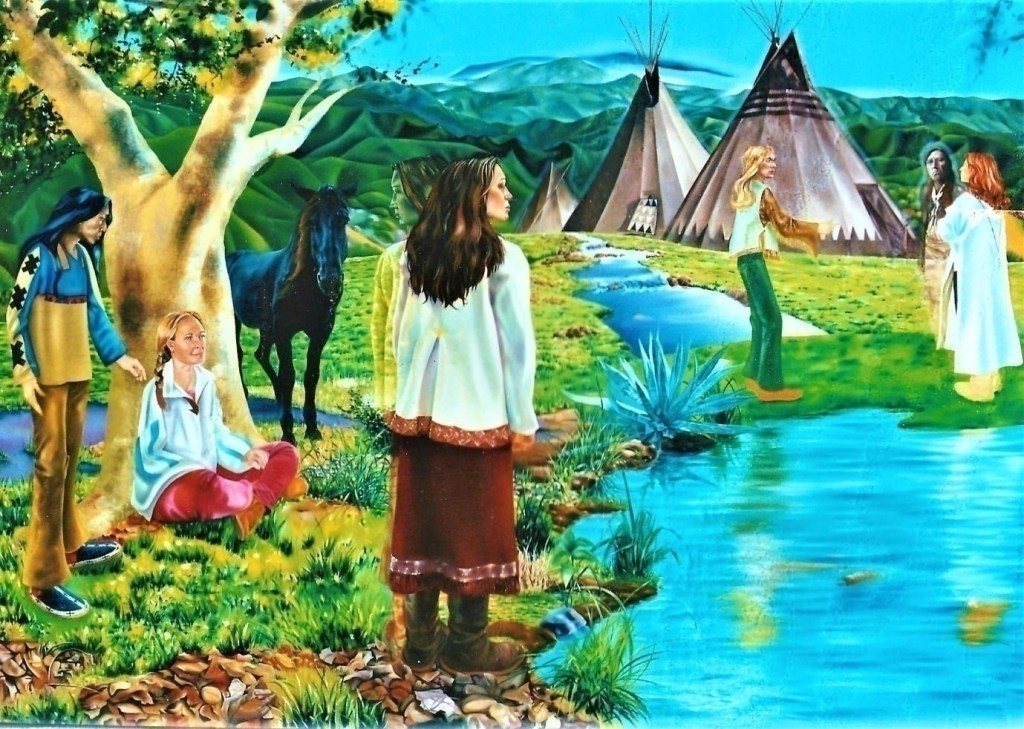
‘Past Life Present’ 2001, oil on canvas
My work had got bigger and bigger over the years, from tiny black and white graphics to this, a massive, colourful oil painting on canvas. It is about a vision I had of me and my relationships to people in a past life as Native Americans. The other people in the painting are from my present life.
I met a beautiful man called Ben at Dorland, who made amazing sculptures in wood. We hung out together throughout the month. I realised later in the month that I had fallen in love with him, but he had a girlfriend so I never told him. Keeping my feelings to myself was hard. When I left Dorland, I got onto the Greyhound bus and began to feel ill. I felt like I was having a heart attack. I was getting up to ask the driver to take me to a hospital when I instinctively pulled out a piece of paper and pencil and started writing. I wrote a 46-verse love poem about Ben on the bus and when I had finished, the pain in my heart had gone.
Dorland was an amazing break from my madness and gave me the motivation and energy for the beginning of a new life.
i want a feature in the Big Issue the ‘ last seen’ scenario ‘she seemed fine at the drop off!’ parked at the school gates waving goodbye to boys 6 and 8 in her favourite coat, non branded, clean, parka green.
the despair of staying here makes my nurture seem like torture there’s only comfort in escape i want to get away up the M8 music on full blast shoebox of stashed cash start a new life no questions asked.
but i imagine you led back to the school only a weary teacher to wait with then driven back when I don’t return to a house no longer a home.
i won’t leave my children a legacy of loss. i cant be like them. The Missing are those who go and stay gone i’ll be the one dashing back for the pick up shouting ‘sorry i’m late’ last seen at the school gate clutching kids.
The physical techniques are well-known. There is a whole weird subculture online devoted to them. But I refer to the psychological and societal techniques. First, the man should be born into a liberal Western family, which retains just enough unconscious traditional expectation of high male performance as to confuse the young male mind, growing, as it would be, in a free-thinking family which claimed to be indifferent to gender roles. Second, the man should grow to be bisexual, but not to be too comfortable in his bisexuality. Third, his parents should divorce at a young age, with the father leaving the family and maintaining only brief fortnightly contact. Fourth, the man, as a teenager, should over-use alcohol, cannabis, and porn, should go to the wrong university, should leave early and not get a degree, should enter into homo-erotic friendships where neither side admitted the homo-eroticism and where the other guy would dominate the friendship, making it difficult for the man to socialize in a wide and balanced way; and should break up with his first girlfriend, painfully, after a couple of years. Fifth, the man should develop serious mental health problems in his early 20s, feeling like a failure, should make friends with people who later killed themselves, and should have all his prospects for making a living destroyed by peer pressure, the expectations of the university-uneducated and a persistent nagging low self-esteem. Sixth, the man should go through his 2os with no sexual contact with anyone, forcing his sexuality to become auto-erotic, exhausting his orgasms to the point of no return, almost breaking them. Seventh, the man should finally find a long-term partner, but whom he is ultimately not suited to and does not have regular sex with, ending in a protracted and tortuous break-up.
And yet, all this may not be quite enough to totally ruin a mans orgasm, because the man may marry a kind and understanding person, of whatever gender, who may help him to explore his sexuality, who may help him to recover his hardness, as well as his softness, who may support his critique of this abusive society, who may stay with him till the end.
Featured image: ‘Lunchtime Concerts’ 1979; Pencil and collage on paper (College project)
When I left college in 1981, I was offered a council flat on the eighth floor of a tower block in Wood Green, London, so I took it. I had to go through seven doors and a lift to get out, but I didn’t think about it then, I was living in a totally ungrounded, drug-filled fantasy world, and so being in the air suited me. I imagined it as my high-rise apartment in New York. The famous artist. This is who I believed I wanted to become. But I was extremely self-critical, not even knowing I was being so hard on myself. It had been a normal part of my childhood. This and my lack of confidence kept me in a cycle of wanting to block this harshness out.
After 3 years at college, I had had enough of Graphics and began doing freelance illustration. I did commissions for The Magic Circle, BBC, Channel 4, The Fiction Magazine, Spare Rib, World Wildlife Fund, Live Aid and various publishers. My work was small, black and white in ink or pencil, and it was detailed.
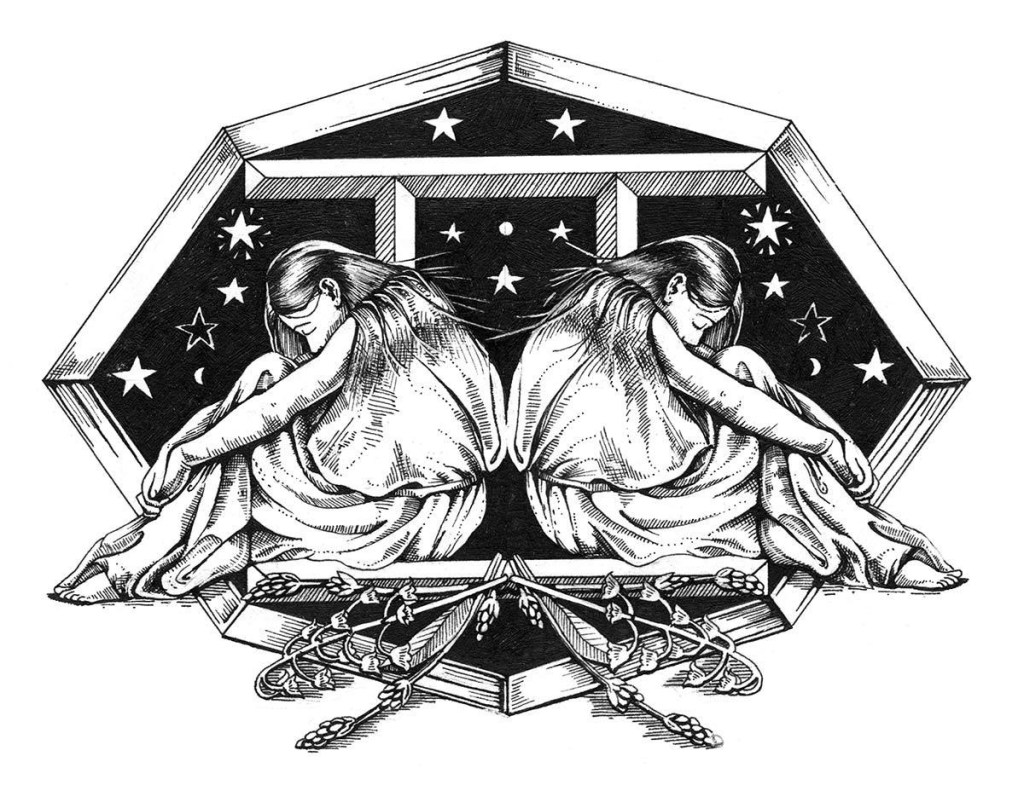
Gemini. A commission for ‘The Complete Astrologer’ by Derek and Julia Parker. 1981
I also explored my own realistic and abstract artwork and crafts, sculpture, clothes design, generally with a nature or recycling theme. Artwork was my healing journey from a childhood bereft of emotional comfort.
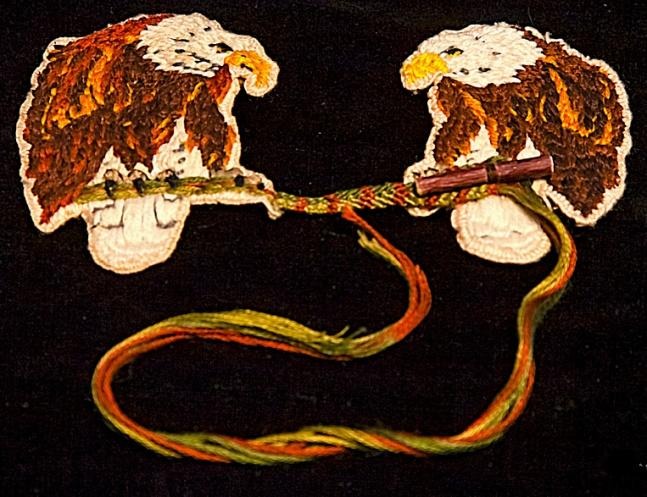
Embroidery eagles for a shirt collar. 1981
My work got bigger and bigger in size as my confidence grew.
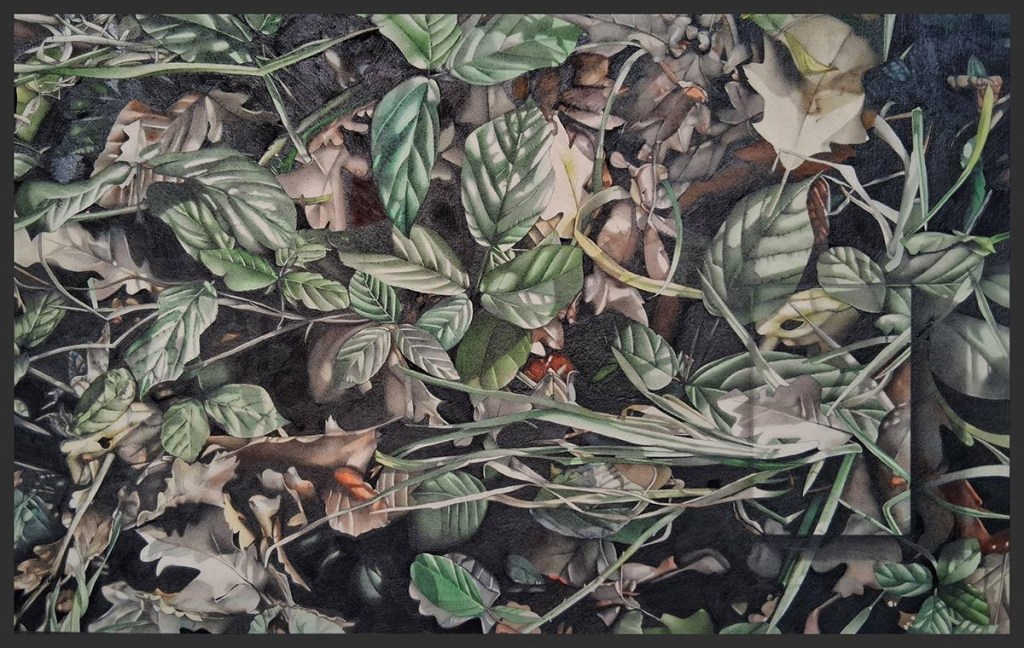
‘Blue Grass’ 1981 pencil and watercolour on paper.
In 1982, when I was 23 I had a motorbike accident and broke my leg in three places. The woman I was living with, Yvette was on the back and thankfully only bruised her knee. It was a complex fracture and they couldn’t operate immediately as I had friction burns on my leg. I found myself in traction, (they put a pin through the ankle and dangle a weight from it to pull apart the bones so they can realign them. Sounds like torture and it was!). Obviously some nurses and doctors were considerate but my experience of doctors standing at the end of my bed with their white coats on and clipboards talking about my condition without including me, stuck with me. Also asking a nurse for a bedpan and being told it wasn’t time for the bedpan round and I must wait. These were just two examples of emotionally unsafe behaviours that stayed with me for a long time. It was frightening.
‘The Resting Biker’ 1982 oil on paper
Yvette came to visit me every day and when I came out of hospital I vowed I would never see a doctor again as I had felt so out of control. It was another pivotal moment where I began unconsciously building my need for complete autonomy and to find a healing space. The accident completely woke me up. I wanted a more spiritual life and I started to explore complementary medicine, diet and fasting to improve my physical health.
I met Simo and Checca, the Italian twins at the women’s bathing pond at Hampstead Heath. Yvette moved out and they came to live with me. They had been brought up in rural Italy and moved to London when they were 11. They had gone to school at the famous Summerhill and were very open minded. They were outgoing sannyasins, disciples of Osho, an Indian Guru and I loved living with them. Through Osho, I learned about meditation, mysticism and spirituality. It was comforting and life affirming. Seeing life through the perspective of spirituality created a positive outlook. I also found a book called “You can heal your life” by Louise Hay and read it over and over. Its basic principle is “you are in control of your mind; it is not in control of you” and she provides exercises to let go of past painful conditioning and find that empowering place of being in control. She is also the queen of positive affirmations.
Simo, Checca and I visited Italy for months and I loved it there. They both also knew about wholefoods and introduced me to cooking brown rice.
In 1987, when I was 28, I was having a conversation with my friend Roger and someone I had just met. This person asked me what I did for a living. I avoided the question and mumbled something about crafts. Roger said ‘she’s an artist!’ That was the first time I began to give myself that title.
That same year, Checca and I went to live in Italy. This created the real foundation for my connection with nature. My first activity was to collect figs from a tree and eat them, I loved it and it made complete sense to me. We collected and cracked pine nuts on a stone and made pesto with fresh basil. We stayed with Checca’s dad for a while. He was an accomplished artist. He foraged, including mushrooms.
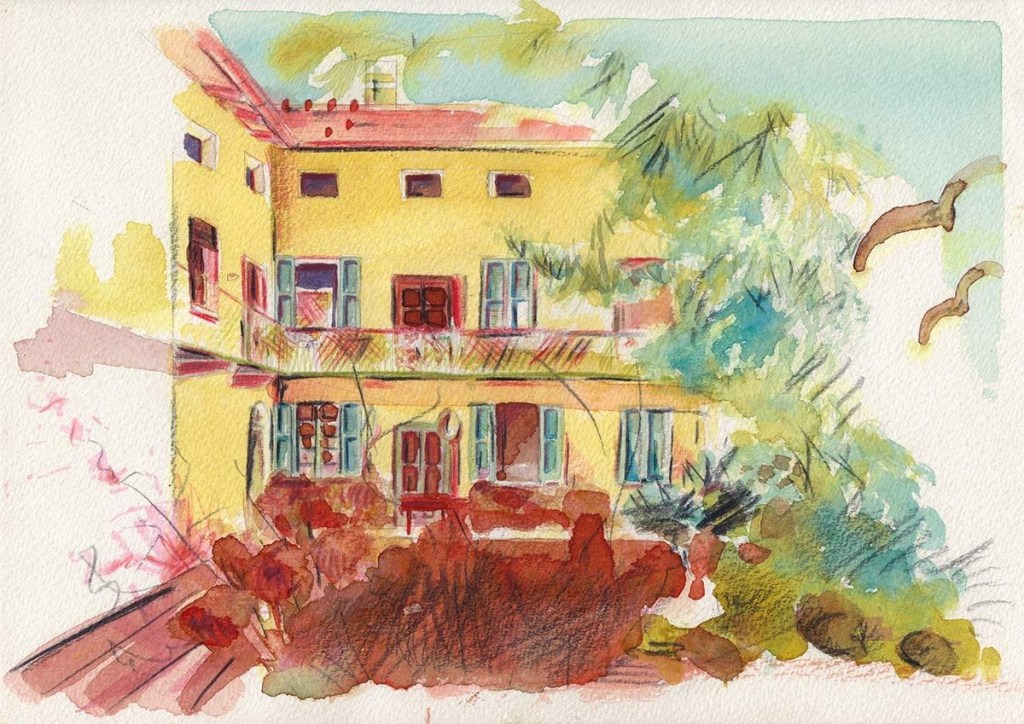
‘Antonio’s Garden’ 1990 ink on paper.(Checca’s dad’s house)
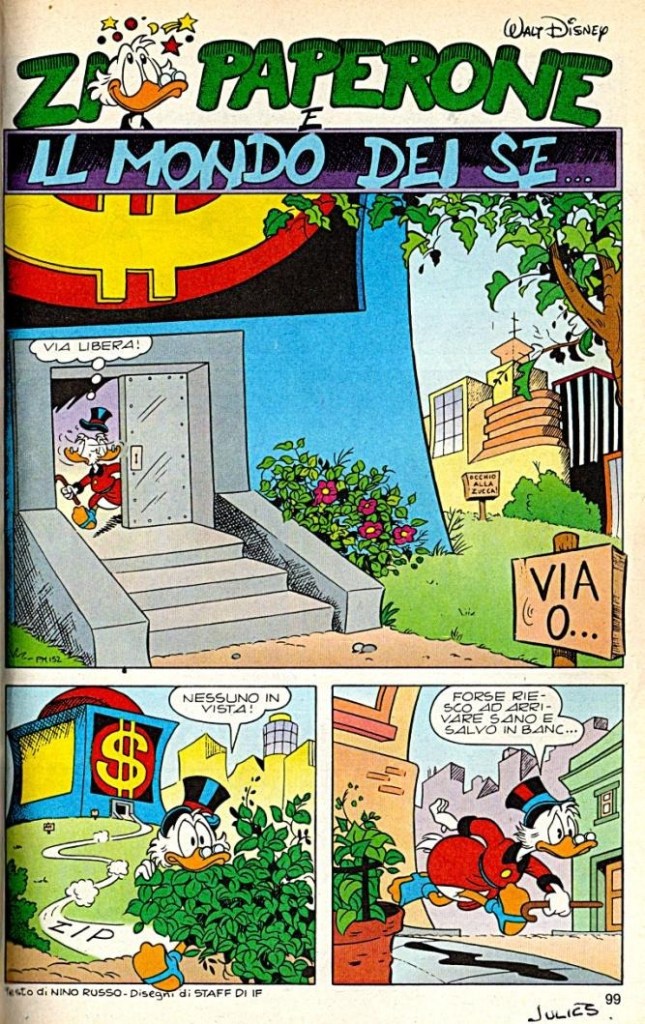
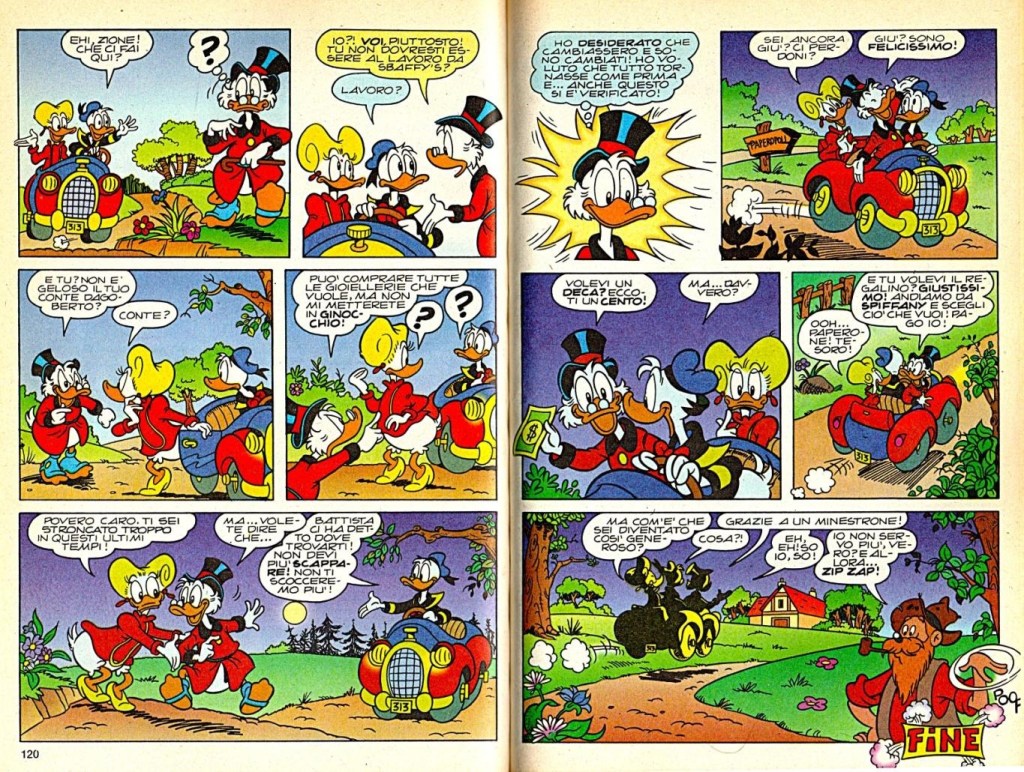
After almost a year with Checca’s dad and also staying at our friend Roberto’s house, we found a house to live in at the edge of a quiet village in the countryside. I meditated, (working on my inner demons of depression) and got a job working for Walt Disney drawing cartoons of Donald Duck for ‘Paperino Mese’. I would work at home during the week and go to Milan on Saturdays to the Walt Disney Studio to have my work assessed.
My drawings for ‘Paperino Mese’ 1991
In 1990, when I was 31, I came back to the flat in London which had been kept on by Simo. Checca stayed in Italy, Simo moved out of the flat and I lived there on my own.
As I was healing, the eighth floor of a noisy tower block next to a main road with noisy neighbours all round me and no sound insulation, became a place of deep suffering. I could even hear my neighbour Tracey downstairs sweeping the floor. The sound of Tracey’s bass-heavy music in the night for two years and environmental health being unable to catch her brought me to a nervous breakdown, a catharsis, in 1998 and I was sent to a psychiatric hospital for a week. I then spent further spells in crisis centres and took anti-depressants until one day during a massage at the crisis centre, I broke down and exclaimed to the masseuse, “I’ve lost my soul”. I stopped the anti-depressants immediately.
The outer issue was always noise. The noise that humans create which, to me, made the sounds of nature harder and harder to hear. I longed for silence and the only sounds being the sounds of nature, I was obsessed with it. I felt breathless without it. I told a carer in the crisis centre that I longed to hear the sound of the birds and she said “well, we’ve got a birdsong tape!” I could have screamed; she didn’t get it. I wanted to be so immersed in nature that there was no separation. Birdsong on a tape was just another human invention and all part of my disconnected environmental crisis. I wanted the real thing, but I was on the dole, DHSS (Department of Health and Social Security) feeling ashamed and guilty. My friend Prabhu helped when he said, ‘Don’t feel guilty, it’s DHSS—Divine Help for Spiritual Seekers!`. I was living on £50 a week, no money in the bank and living, ‘existing’ in a noisy tower block in London. Sometimes I sat on my balcony at the flat with my hands over my ears, rocking from the insanity of the noise; traffic, household noises from uninsulated flats, police sirens, fire engines…and nature seemingly so far away out of my reach. My solace was to walk through Alexandra Palace park to Crouch End to buy my shopping from the health food store. Alexandra Palace was a walk across a little park next to my allotment and over the railway bridge. I also started to see counsellors and this gave me a feeling of strength and security. However, I couldn’t get out of the flat. No-one wanted to home swap to a tower block, I was trapped.
‘A Fine Line’ 1998 oil on canvas
I was continuously burdened with the thoughts of how to raise enough money as an artist to get a mortgage and buy my own place. It was a crazy idea, I was an Artist! Money was an alien concept, and consistently making money without feeling utterly stressed was even more alien. I had been on and off the dole for years, coming off to do a few months of freelance work and then signing back on again. I couldn’t cope with the pressure of relentless work; it sucked the joy and the purpose out of making art. Thinking only of the conventional route clearly wasn’t for me, but what was the solution?
I spent the next few years going in and out of the crisis centre, figuring out in my mind, what I wanted. On one visit, I met a man who did photography. He showed me one of his pictures. It was a barge going through a tunnel and there was a small bright light at the end. It made me ask, “What is my light at the end of the tunnel?” and my first thought was “America”! So I made that a goal. Unbeknownst to me at the time, my trip to America was to be another foundation for my deep inner craving for a more natural life.
There are all kinds and manners of farming in the rural county of Devon, in South West England. There are large scale industrial farmers of beef, dairy cattle and sheep, heavily subsidized big business, right down to subsistence level organic farmers, and down again (or sideways) to hobby farmers, and everything in-between. My friend Dave was in-between. His family kept a few cattle, for home beef consumption but also as a small supplementary income to be drawn from their few fields on the edge of the village. Not a personal hobby as such but certainly a tradition in those parts.
Once, Dave made to attack me with a large kitchen knife. He was laughing maniacally. We were in his kitchen at the time. We had drunk a little. We were used to play fighting on occasion, but he had never picked up a knife before. He swiped it very close to me, advancing up the narrow kitchen, and I shouted for him to back off and told him not to be so stupid. He eventually ceased the knife play and apologized. I thought he had lost it. I was scared.
Dave was one in a series of intense homoerotic friendships I have had in my life. And like the others, it ceased quite suddenly. I feel guilty about this, as though it was me who suddenly ended the friendships, but I dont think that is exactly true. It is more complicated. Dave once told me he was (is) gay. Now he is married to a woman, with kids. When he lived somewhere else in Devon for a while, away from his family home, before he got married, he heard his neighbours talking about him through the wall. He became psychotic. I was not there to help him. I had had enough psychosis of my own to deal with.
Once, I saw him after a long break. I asked him how his dad was. He replied in a deadpan way, ‘He’s dead’.