
DIARIES & MEMOIRS: COUNTRIES A-Z, Ecology of the absurd, England, Exclusive to COTW

Building Silent Haven: Chapter Four

Back once again in London, I was still smoking cigarettes and marijuana and drinking alcohol. I had been suffering from migraines ever since the accident and knew these didn’t help but I was addicted. I desperately wanted a clean and natural life. In Italy I had read a book called ‘The easy way to stop smoking’ by Allan Carr. I had stopped smoking for about four months and then started again. So I decided to take one of his day workshops. A group of us were shown to ‘Parker Knoll’ recliner chairs with ashtrays next to them and we were allowed to smoke as much as we liked!. In the corner was a huge pile of empty cigarette packets. During the day, the group leader talked to us about what was hooking us into smoking and at the end of the day he gave me a business card and said “if you have any problems call me”. I left, passed a newsagent and thought “I’m not buying cigarettes tonight; I’ve just spent £140 on a workshop to stop!” So I didn’t smoke that night. When I woke in the morning I burst into tears. I remembered the group leader suggesting calling if there was a problem, so I did. He asked “What are you feeling?” For 28 years I had woken up and lit up a cigarette, wanting not to, and this morning I had woken up and not even had the desire to light a cigarette. “Relief!” I replied. I’ve never had a cigarette since and the marijuana and alcohol also dropped away and I’ve never had them since.

In 2003 I got an allotment at Ranelagh Road, which was across the road from my flat. I was 44. The allotment was a tiny haven away from the flat and my worries. I met Richard there; he had the allotment next to me and lived in a flat on the other side of Wood Green. Richard was extremely disassociated which was very painful for me. Suddenly he would disconnect from me. He mirrored my lack of self love. For example, I would make dinner for us and in the middle of a conversation; he would get up and walk out. I would try phoning him but he had switched off his phone. Sometimes he would not contact me for two weeks and then call as if nothing had happened. I found it excruciating. However, I was grateful to Richard as he gave me two major gifts, the first was my introduction to the art of looking at and mastering my thoughts and emotional responses and the second was a lightbulb moment which introduced me to the amazing freedom and reality of living and working on the land.

Richard had a big open allotment space and made very uniform raised beds. He planted Californian poppies, nasturtiums, and calendula as companions to his vegetables. Both nasturtium flowers and leaves are edible as are calendula petals. They make salads look beautiful. The vegetables were growing well as he fed the tomatoes with nettle tea and the broad beans and potatoes with ash. I was jealous, it looked beautiful. He was an artist. I felt competitive and threatened by his work. I would look at my allotment and criticise it. This was my usual painful reaction to other people’s creativity I admired.
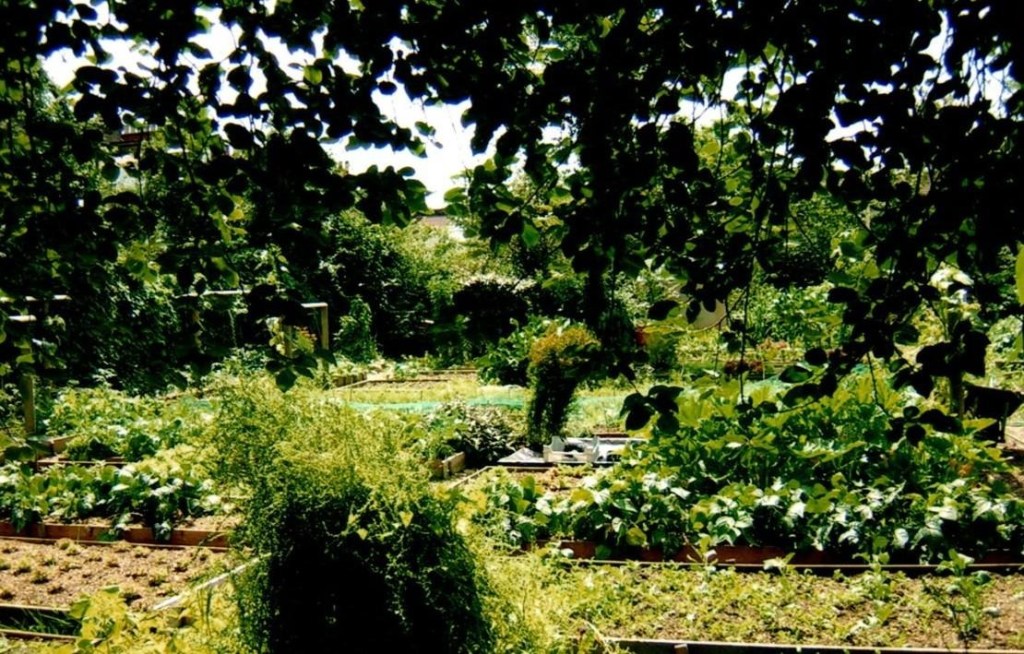
Richard’s allotment

My allotment was the complete opposite; it was right at the back and under some huge trees, a shady woodland area.
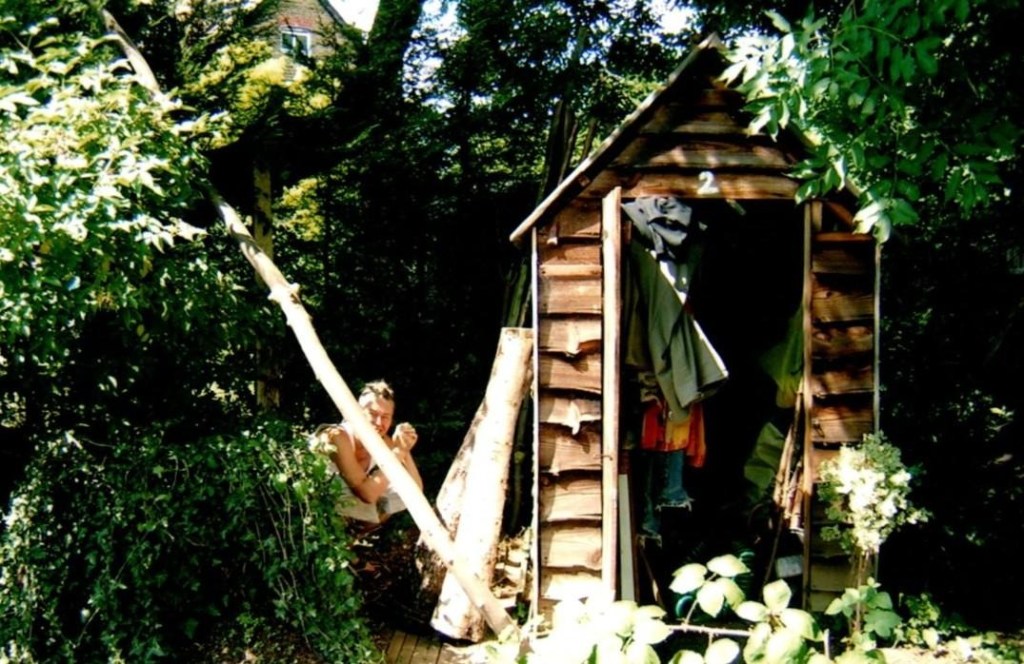
My allotment

At first, I completely ignored its character and made a round bed in the middle and planted carrots. I had always wanted to grow carrots, pick them out of the ground and eat them straight away, so all the goodness was still in the vegetable. As soon as a vegetable or fruit is harvested it starts to lose its properties. It amazes me how people survive on food which has travelled many air miles.

The carrots didn’t grow. I began experimenting with vegetables which liked a bit of shade. I had limited success. Kale grew reasonably well but growing salad was hopeless. The shade made the area more damp which attracted more slugs, salad being a delicacy for them. I tried spinach, swede and leeks, also with limited success; my heart wasn’t really in it. By this time Richard was supplying me with veg he grew anyway. So, I gave up.

Richard never seemed to eat the vegetables he grew. He made a pond in the communal area, and I built a fire pit with some bricks, and he would go off to Wood Green, just around the corner and buy meat for himself and cook it on the fire. I’m a vegetarian. I don’t like killing animals, so I won’t eat them.
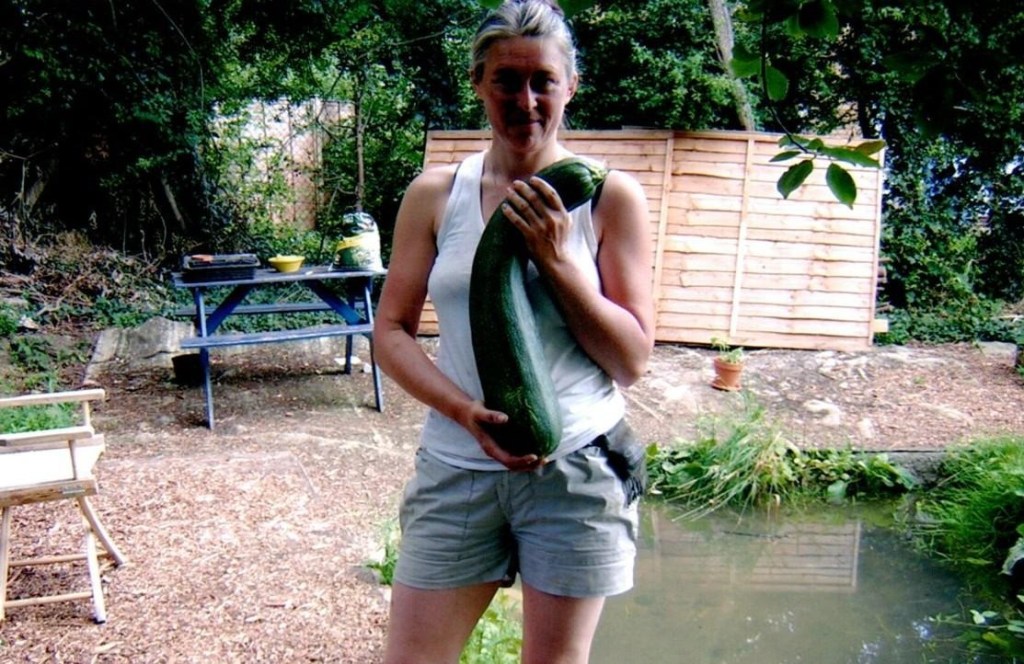
Produce and the pond

I became a frequent visitor to the local garden centre and usually couldn’t resist buying a plant or two. I wasn’t discerning, if it had pretty flowers, I would buy it. They rarely lasted. So, as with the veg, I started to look for flowers for shade. I became obsessed by which plants I could grow in my plot. I realised I was much happier with flowers than vegetables. I planted geranium, bluebells and wild garlic. 

I would go from the flat when it was too noisy to the allotment, which also had an assortment of human noises, then to the studio, then when that was too much, back to the flat! That is how I managed my noise sensitivities. I was also constantly asking people to turn down their music, which sometimes worked and sometimes got negative comments. I felt permanently unsafe.

In the summer of 2003 Richard introduced me to Wwoofing (Willing Workers on Organic Farms). Farms and smallholdings write about themselves in a booklet and Wwoofers choose places to stay. The host gives us a bed, food and teaches us about the land and growing. In return, we work (generally 7-8 hours a day) Our first host was Alison. Alison and her husband Tristy built their own amazing house and planted a 5-acre woodland in Cornwall. I was so impressed. They had lived in a caravan and built from the ground upwards. She advertised free breaks for Wwoofers and we stayed there for a week without having to do any work! They were philanthropic, kind and eternally generous people. Richard and I stayed in their tiny hut in the woodland which had a cooker, a bed and a chair in it. I loved it. I was struck by a note Alison wrote in the hut which said, “Please do not cut down any leaf or branch from this woodland”. I loved this sensitivity and honour towards the trees. Alison and I connected, and she and Tristy became my friends. The kindness of her offering free breaks was only the first in a long line of future kindnesses which, quite frankly, literally saved my life.

Subsequently, whenever I broke down from the noise or fear of living an unnatural life in London, I would ring Alison. I would often say I wanted to visit and then change my mind as I couldn’t face the journey. She was always there for me, every time I phoned; she would give me time and counsel me. Quite often she would say “come down, just let me know when you are on the train” and I would go to their safe haven.

Firstly, I would stay in the hut in the woods and later, I slept in their daughter Lucy’s beautiful old bedroom in the house, where there were flowers from the garden by my bed. Alison would feed me, counsel me and look after me until I stopped crying and the headaches went away, and I would begin to feel human again. I am blessed to know such beautiful and generous people.

DIARIES & MEMOIRS: COUNTRIES A-Z, Exclusive to COTW, Reflections, Ukraine

Dancing During War (Ukraine travel memoir) #3: Thursday August 14, 2024

by Keith Hennessey, 2024

Using my phone I read a few things about the war today including the surprise Ukrainian incursion into Kursk Russia. I also tried to learn more about the Air Alarm system so I could emotionally prepare for my first air raid siren. I joined an English-language Telegram channel, which was recommended for tracking potential bombing.

Then I researched queer Ukraine and learned about an amazing 2018 photo project and exhibition featuring queer soldiers within Ukraine’s “Anti Terrorist Forces.” The photo project affirms the presence of LGBTQ+ Ukrainians in general and heroic soldiers in particular. Despite the subjects’ identities being hidden, the photos bring queer visibility and pride into public space.

I went to two large old Catholic churches, both with extremely elaborate interiors. Murals, arches, wood and marble, tiled floor designs, statuary and icons, alcoves and pillars… The first one had a sign outside requesting prayers for Ukraine.

A little later, after visiting a couple second hand stores, I passed a church from which I could hear singing. I entered to a Catholic mass honoring “defenders,” which is how Ukrainians refer to their soldiers. Alongside the interior of the church were photos of hundreds and hundreds of deceased defenders. I had read that both sides were under-reporting their war dead to not weaken national esteem. But everyone knows someone who has died and even more who are physically injured, traumatized, and displaced from their homes.

In a small plaza outside the church I witnessed a combination of info display and memorial for the over 900 Azov brigade soldiers and crew still held in Russian prisons since 2022. The Azov brigade began as an independent “army” made up of predominantly Russian-speaking Ukrainians who were then assimilated into the Ukrainian National Guard and were the last line of defense in the terrible siege on Mariupol. They are highly regarded in Ukraine for their bravery and sacrifices, and there is a movement to keep pressure on negotiating prisoner release.

There’s a lot of follow up study if you’re interested in Azov, torture as a war tactic, and the siege on Mariupol including:

  • The extreme torture perpetrated against Ukrainian soldiers.
  • The critiques of Azov members with neo-Nazi affiliation, and the normalization of radical right Ukrainian nationalism.
  • The bombing massacre of a theater/cultural heritage site used as a citizen refuge in Mariupol.

Walking back to my temp rental I saw a young guy with his bandaged foot casually yet intimately supported by his buddy’s leg as they sat on a street bench. When I looked closer I saw that he was missing half his foot. I’d heard that I would occasionally see wounded soldiers including amputees with prosthetics.

My first appearance at the weekend Contact Improvisation festival organized around my visit was an informal lecture on the politics of dancing, and the political potentials of CI. My talk-discussion was attended by 35-40 people, including two people I’d met before, plus a small livestream audience in Kyiv. The talk happened in a very new studio run by a physical theater company in a renovated-gentrified factory complex of multiple buildings. Next door was a hip gym called Smartass whose logo looked like a tech startup’s.

My talk offered three ideas or frames for thinking about dancing as political engagement and political healing. Ideas and inspirations I’ve been working with for at least 10 years:

  1. Gustav Landauer’s analysis of the state as a system of relationships, a mode of behavior, that cannot be destroyed as an object but rather needs to be replaced by contracting new relationships, by treating each other differently. I proposed the studio and CI jam as a research lab to develop, rediscover, and practice these new relationships.
  2. I introduced a few women from US Black feminism whose work considers and responds to oppressive power and state violence. Quoting Audre Lorde and adrienne marie brown I encouraged them to consider self and community care during a multi-year invasion by one of the world’s biggest military empires as “self preservation” and “political warfare,” and supported care-tuned dancing with brown’s “we learn to love by loving.” Using the touch and change prayer from Octavia Butler’s dystopian novel Parable of the Sower, I offered some fresh ways to understand touch and consent as tools of social
    transformation.
  3. My final idea was to propose solidarity as an ethical goal of these dancing, caring, loving, touching experiments. Identifying the radical right, neofascist, and anti-democratic movements around the world as an intensification of neoliberalism’s crisis of solidarity, I proposed CI as empathy training that might expand our capacity for solidarity, to care for those we don’t know, those who are different from us.

After each idea the circle was opened up to comments, questions, discussion. Several of the questions circled around the gap between the studio and the world, the counter cultural gap, the power gap, the hopelessly small scale of the CI network. At one point, even though I had decided to not critique nationalism given how it was functioning as a primary tactic of Ukranian survival and defense, we got into it. I suggested that nationalism is resonant with the tactically effective yet dead-end strategy of identity politics. This was the edgiest thing I said. One person pushed back and said it was crucial to their survival right now. One person thanked me for bringing it up. One person said let’s move on. I apologized. One person responded, we forgive you, because you dared to come here.

After the talk there was an open CI jam. Approximately 30 people stayed to dance. As usual I watched more than danced but I had a couple of lovely dance connections. The floor was hard but new.

Will there be dancing during wartime? Yes. There will be dancing.

At the jam’s closing circle one person praised that there were dancers from at least 7 different cities including a few from Kharkiv and other places experiencing active bombing. They were so grateful to have Ukrainians from around the country dancing together at a jam. One of the long term CI teacher/organizers in Ukraine reported that she could feel love in her dancing tonight, maybe for the first time in over 2 years. A young enthusiastic guy finished his comments by saying, “Slava Ukraini (Glory to Ukraine.)” Someone asked for a moment of silence for the “defenders, without whom we wouldn’t be dancing.” The “moment” lasted six full minutes. It was intense and reverent.

After the jam a young dancer came up to thank me for talking about nationalism. She said she was from the Eastern part of Ukraine, in the contested Donbas region. Speaking Russian as a first language she felt excluded from Ukrainian nationalism despite her identification with Ukraine and critique of Putin’s Russia. I asked her where she was living now and she replied, Krakow (in Poland), describing it as “heaven on earth.”

A couple people including my main host took me out for pizza where the conversation continued for another hour. A young man explained why he hadn’t registered for the draft and how he was prepared to defend his refusal to military recruiters who sometimes pick up young men in the street. He felt that his family had served enough already. His older brother was at the front for five years and is now disabled. His father, a former journalist previously jailed for criticizing the army, was now serving in the Ukrainian air defense. He said, “It happened in late 90s. My father wrote about government crimes in a newspaper. One evening, he was illegally abducted by the police. Without a trial and unlawfully, they held him in the forest for half a year. We didn’t know if he would return alive.”

It was getting close to the midnight curfew and we were all tired so we hugged goodnight.

Collapse chats & diaries, DIARIES & MEMOIRS: COUNTRIES A-Z, Ecology of the absurd, Featured blogs, sites & lit works, Germany, Popular & established authors

The hottest day

By Tadzio Mueller; originally published in German on the blog Peaceful Sabotage. Republished with permission.

Dear people,

It’s Saturday, June 27th, 6:27 a.m. I’m sitting in the kitchen, a small pot of green tea beside me, my laptop on my lap, writing these lines. This isn’t my usual routine; when I work on a Saturday, I usually don’t start until 10 a.m., after I’ve had a bit of a lie-in and finished reading the morning paper in bed. But today is supposed to be one of the hottest days in Germany since records began. Yesterday, a weather station in Saarbrücken recorded 41.3 degrees Celsius, the highest temperature ever measured. Today, this record will likely be broken; 39 degrees Celsius is forecast for this afternoon in Berlin, the highest temperature I’ve ever experienced in Germany. Neither my office nor our apartment has air conditioning, and I’m under pressure to finish this book, so here I am at 6:46 a.m., already hard at work, because it will simply be too hot from midday onward. It will be too hot to work, too hot to think, too hot to tell stories. It will simply be too hot for everything. End of June. In northern Germany, not in Ecuador.

And this heat wave is just the beginning. The world’s oceans are warmer than ever before, or at least not within the context of a stable, human-friendly climate. In the Pacific, the “Godzilla El Niño” is gaining momentum, and in the North Atlantic, the “cold blob” is causing alarm, already influencing the monsoon in India and representing the first clearly visible sign of the coming collapse of the AMOC, which will one day trigger a climate catastrophe of its own in Europe. When? We don’t know, but the date is getting closer and closer since I started reading the studies on the subject.

It’s the last weekend in June, normally a weekend packed with festivals, Pride marches, village celebrations, and whatnot – and news is pouring in from all over Germany that most of them are being canceled this weekend. My good friend and fellow collapse enthusiast Scully wanted to go to the Christopher Street Day (CSD) in Ilmenau: canceled because of the heat; I had considered going to the CSD in Bernau with Wolf, like Scully, to make sure there were more of us there than potentially disruptive fascists: canceled because of the heat.

Yesterday, the hottest day in Germany since records began, roads collapsed, people died, and Berlin felt like a ghost town; nobody wanted to be outside, nobody wanted to be in the sun. About an hour north of Berlin, the left-wing alternative music festival Fusion is taking place this weekend, as it always does at the end of June. Around 50,000 hedonistic holiday communists are partying there exuberantly for several days, a significant number of them drunk, stoned, or high on amphetamines. I myself spent many a sleepless night there in my younger days. For several years now, I haven’t gone to Fusion myself, but every year when I’m not there, I experience FOMO, or ” fear of missing out .” Someone else might be having more fun than me.

This year I’m not worried about missing out. This year I’m worried that people will collapse there in droves, possibly even die of heatstroke. I’ve read *The Heat Will Kill You First * and * Ministry for the Future *; I know how, in extreme heat, our bodies dissolve in on themselves, how our insides turn to scrambled eggs. I’m afraid of the heat, and this year it will reach up to 40 degrees Celsius at Fusion. I’m afraid that people will simply die a miserable death while partying because, as a society, we’re just not prepared to live in *Hothouse Earth *, as an influential paper described it a few years ago.

It’s Saturday, June 27th, 6:28 a.m. Today will likely be the hottest day in Germany since records began. And tomorrow the record might be broken again. As the well-known meteorologist Özden Terli reminded us in yesterday evening’s news: we are emitting more greenhouse gases, not less, and as I predicted a few years ago, the more the climate catastrophe escalates, the less we care about climate protection.

It’s Saturday, June 27th, 6:29 a.m., and the last report on Deutschlandfunk radio before the 6:30 news is about the lack of civil defense in Germany. I didn’t hear everything; it’s still early, and I’m just making my green tea. A middle-aged man is asked when he last experienced a siren alarm: he replies that it must have been quite a while ago, perhaps 40 years? I promise myself I’ll listen to this report again later; maybe I’ll find a few more good quotes in it.

Quotes that are supposed to prove something? That I woke up on June 27th in a different world than the one I described in the last chapter. A world where “disaster preparedness” is something to be ridiculed, something to be dismissed as “fascist prepperism” with all the self-assurance of those who have never had to react to a disaster themselves. A world where it’s becoming increasingly clear: disasters are coming, in fact, they’re already here. You can prepare, or you can’t—but if you don’t, then things are going to go wrong.

June 27, 2026, is one of the few days I’ve experienced that truly feels like this: like a world on the brink of collapse. A world where everything is falling apart. A world that, in a crucial sense, is coming to an end. And this is casting its shadows. Shadows that many are still ignoring. But the exciting and dangerous thing about heat is: it’s hard to ignore, and expensive. So we now have a brief window in which we’ll talk about heat waves, climate collapse, and civil protection. The window will close again quickly because of our society’s tendency to deny the truth. But perhaps it will stay open long enough for me to finish my book about collapse and preparing for collapse. Cognitively, that would be stupid, because heat makes you stupid. But symbolically, it would fit. And stories are all about symbols. So here we go : the world is ending, this book will soon be too, let’s wrap it up, people.

With diligent but heat-worried greetings,

Yours truly, Tadzio

DIARIES & MEMOIRS: COUNTRIES A-Z, Exclusive to COTW, Reflections, Ukraine

Dancing During War (Ukraine travel memoir) #2: Wednesday August 14, 2024

by Keith Hennessey, 2024

I came to Ukraine because I hate war and imperialism and wanted to extend solidarity to people suffering from it. Also I’m deeply curious about, and inspired by, how people, and artists in particular, think-feel-work-dance-heal-create-connect under extremely difficult conditions. How to survive a war? How to keep dancing, or not, during a war? From previous experiences* and extensive political reading I know that witnessing is a powerful act of solidarity. I came to listen and look, with a willingness to be changed and a commitment to not turn away, not be silent. I was sincerely invited and warmly welcomed.

I also came because I’m restless and confused with my own life which teeters between fabulous, and lonely alienated political despair. With the overly scheduled and distracted attention of my everyday life I don’t have the capacity to focus or learn at the level I’d like to be engaged, at the level I have found only when I leave home and immerse myself in a place and a history with the people most impacted.

I also came because it was easier, logistically and culturally, than going to Sudan, Palestine, Venezuela, or Congo, where I am also interested in learning, witnessing and offering solidarity. In early August 2024 I had paid work relatively nearby in Vienna and I had been to Kyiv before the 2022 invasion and knew some Ukrainian dancers. Karl Frost, a dancer friend, had made the trip a few months earlier to offer contact improvisation (CI) workshops in Kyiv and Lviv. Karl connected me with Lilia, a dancer-organizer from Lviv who organized a talk, classes, and dance jams around my visit. I declined invitations to go to Kyiv because the trip is long and the likelihood of bombing and regular air raid sirens was much higher.

In discussing what I might offer in this situation, Lilia said, “we’re trying to hold together a dance community during the war, to keep our love and humanity alive.”

I responded:
“I am not a therapist or trauma specialist but I recognize the healing or calming potential of the practices we do in a dance class, in somatic awareness exercises, in paying close attention to our breath and body sensations, in tuning in to another person or group. Most healing focuses on the individual. I am more interested in “political healing,” which recognizes how we share many symptoms (anxiety, depression, alienation) with other people (and other beings) and that our pain/harm is caused by social and political forces more than by isolated individuals. My work tends more to the whole forest than to the individual tree.”

Lilia responded:
“Dear Keith, First of all I appreciate your desire to come and teach in Ukraine. For us it’s very important when people abroad would like to come and to spend some time in Ukraine. To see how we keep on living and keep on dancing in this crazy world. In a war world full of violence, anger and horrible things around, somehow we choose to love, to be kind and to be honest with each other. It is a miracle for me. How is it possible in these hard circumstances to choose the humanity? We are living in the high risk right now. It’s a revolutionary world. For me CI practice is kind of the same revolutionary dance form with a high risk and a strong survival mode.

CI practice is supporting our nervous system and is helping to survive our body both physically and mentally. In your workshop in Ukraine, Keith, I’d like to experience how the physicality of CI practice meets our Ukrainian context. Through the CI exercises focused on physicality and gravity. Through the scores and performative structures. How the Russian war changed us and keeps on changing. How the political and social forces change us. How do we meet these changes? How open are we to speak and to dance with complicated things in our lives — like war for Ukrainians and like women`s rights, queer rights and so on? We have done it every day since 24.02.2022. I think we are ready for that risk — putting seeds and uncomfortable questions. We are in survival mode.

I trust you as a CI teacher and I trust your experience. We are not expecting something big from you. We are inviting you to come and dance with us and to share your experience. This is enough. Your active solidarity position is a key. And of course we’ll be healing together while gathering and doing simple CI things but risky
physical things related to the survival mode.”

Due to the ongoing war employing drones and air missiles there were no commercial flights into Ukraine. I flew to Krakow Poland were I had a lovely day of rest, and enjoyed 2nd hand shopping, hipster ramen**, and the hotel spa. Then I took a 7-hour FlixBus to Lviv. I’d heard that the border was unpredictable and we could be there for hours. I was imagining a more militarized situation… maybe like an Israeli checkpoint but it was just slow bureaucracy, not malevolent. Fortunately I had packed a lot of food.

My host Lilia, a dancer, organizer, and mother of two small kids, met me at the station. We hugged warmly despite never having met before. She told me that when she texted me that morning she wondered if I would really come, imagining that I might cancel at the last minute. In the taxi Lilia tried to explain the destabilizing and exhausting unpredictability of the Ukrainian situation. She said they no longer had any concept of the future. She went to a CI festival in Austria last year and observed that people who seem to know their future feel plastic to her after 3 years of war. I asked, plastic? She explained, “They walk around oblivious like plastic people who can count on their future unfolding in a predetermined way.” While in Ukraine I heard many versions of this feeling of alienation or critical distance from people who are not also living with war as a daily reality or who act as if a war at the border of Eastern Europe and Russia doesn’t concern them.

On my first walk around the city center, with its multiple cathedrals and churches over 300 years old, and quaint cobblestone streets lined with vibrant and crowded outdoor cafes, I saw the first visible sign of war. A church with protective covers on its stained glass windows and historic sculptures. After dinner I came upon a street musician who had a large audience of over 100 people, mostly in their teens and 20s. I was attracted by what sounded like a singalong, choral singing. Later I played the recording for someone to ask about the song and learned that it was a pop Ukrainian song from the 90s that many people know. There’s a curfew for everyone at midnight, which I appreciated because here in the dense city center there are many busy cafes, restaurants, bars, and ice cream shops just outside my window.

*My previous war and conflict experiences: Bosnia and Croatia in 1995, Chiapas after the 1997 Acteal massacre perpetrated by paramilitaries against the indigenous Zapatistas, Cairo after the 2011 uprisings, Oslo during and Bratislava following anti-gay shootings in 2022 and 2023.
**Not sure why this is turning into an Eastern Europe ramen tour but for reference, the ramen restaurants in Vienna are cheaper than SF, cheaper in Krakow than in Vienna, and cheaper again in Lviv compared to Krakow. In Lviv a dinner-size bowl of delicious ramen in a trendy spot is US$5-7. I 💜 ramen.

Collapse chats & diaries, DIARIES & MEMOIRS: COUNTRIES A-Z, Ecology of the absurd, Featured blogs, sites & lit works, Germany

Hitzewellenupdate: The heat will kill you first…

By Tadzio Mueller; originally published in German on the blog Peaceful Sabotage. Republished with permission.

25/6/2026

My dears,

I’m in the final stretch of my book-writing marathon, or rather, writing the final season, and my biggest fear is that I’ll botch the landing just like the creators of Game of Thrones botched season 8 – and if that doesn’t mean anything to you: it started out great, and ended in disaster. So there you go 🙂

But the heat wave is raging, and at least in the short term, even as a highly adept society at denial, we can’t completely ignore the impending collapse – partly because it’s so hard to ignore heat. I’ve already written a few texts about heat and my fear of it; here’s the one with the most information on how heat actually endangers us: https://steady.page/de/friedlichesabotage/posts/64ec9c82-e8ea-4819-b92c-d19203735ea1

But the press is also full of interesting articles, so today you’ll get a kind of annotated collection of links, and in English no less – because, to be honest, I’m just posting my daily social media thread #BadNewsOfTheDay here. I hope you’ll forgive me:

Morning, your #BadNewsOfTheDay are largely that it’s very, very hot. Actually, it’s hotter than ever before 😬

1. “The UK has broken its all-time temperature record for June and France has recorded its hottest day ever for the second day running.”https://www.theguardian.com/environment/2026/jun/24/uk-records-hottest-june-day

2. But before I go on about #heat in Europe, let’s recall the fact of #climateINjustice: “Families across Papua New Guinea are facing depleted harvests and hunger after El Niño brought frost and dry conditions that have destroyed food gardens providing sustenance & income for thousands.” https://www.theguardian.com/world/2026/jun/25/el-nino-pacific-papua-new-guinea-png-food-shortages

“While Papua New Guinea is experiencing the most severe impacts, countries across the Pacific were also being affected. As many as 4.7 million people faced increased risks of hunger, poverty and disease due to El Niño-related droughts, erratic rainfall and frost…”

3. Back to sweltering Europe & the way #HeatKills: silently, and very unjustly. “One in every 6 babies in England are living in overheated homes, causing sleep disruption and serious health risks.” Babies, old folks, the ill & unhoused suffer the most. Where’s the #climatejustice movement?https://www.theguardian.com/society/2026/jun/25/one-in-six-babies-in-england-live-in-overheated-homes-analysis

4. Environmental injustice is transnational: those who cause the problems suffer less than those who don’t: “French struggle with heat-trap homes as climate inequality grows: Many of France’s buildings are not designed for hot weather – and low-income housing estates are suffering the worst” https://www.theguardian.com/world/2026/jun/25/french-heat-trap-homes-climate-inequality-grows

Extreme heat is a hell that’s hard to escape: “Extreme heat has led to higher air pollution, a rise in hospital admissions, school closures & train cancellations. It’s caused power cuts to thousands of homes. French nuclear energy output was reduced as heat limited access to cooling water.”

5. Excessive #heat can cause the body to #collapse. Extreme heat can lead to collapse. High temperatures cause blood vessels to dilate, resulting in a drop in blood pressure. In extreme cases, the brain no longer receives sufficient blood flow, and the affected person loses consciousness. https://www.deutschlandfunk.de/hitzewelle-gesundheit-hitzschlag-100.html#Tipps

6. And while Europe is burning, the trade union movement is solidly pro fossil jobs: “2 of Britain’s biggest trade unions are increasing pressure on Andy Burnham not to pick Ed Miliband as the UK’s next finance minister, arguing that his North Sea oil policy has damaged jobs in the sector.” https://www.ft.com/content/74410b7b-cee2-48e0-84d5-77b567530dc3?syn-25a6b1a6=1

7. One big political conflict will be the aircon-question: who gets it, who doesn’t? And who’s negatively affected by it? “Hospitals cancel operations owing to lack of air conditioning: Hospitals across Britain have been forced to reduce services owing to the record-breaking heatwave…” https://www.ft.com/content/fb187483-f496-4432-976e-0aaa9d0506fd?syn-25a6b1a6=1

8. And just for final kicks: “DJ Alok: ‘There’s a way to fly mindfully. Like, I don’t have my own plane any more’.” 🤣 Of course there is. & good for you. The level of stupid self-justifying bullshit we’ll have to endure in the future will be unbearable. But also just a tiny bit funny… https://www.theguardian.com/music/2026/jun/23/dj-alok-dance-music-sustainable-rave-the-world-tour

That’s all for now. Take care in the heat, and if you’re going to Fusion or another festival: drink plenty of fluids, don’t dance too wildly in the heat, and try to be less high during the day. I’m speaking from experience.

I myself will try to finish writing my book at 39 degrees Celsius, which is great because higher temperatures also impair our cognitive abilities. What fun…

With heat-weary greetings,

Yours truly, Tadzio