Featured blogs, sites & lit works, Popular & established authors, SHORT short stories, South Korea

A Fridge Named Deprivation

By Hyoungshim Choi

Knock, knock, knock. Exactly three times. This is what you have to do to get the fridge to ready itself for conversation. It must have been white originally. But now it’s an outdated model, like an old woman, covered in blotches like liver spots and freckles. With its yellowish tint it resembles a yokel from the country, totally devoid of sophistication. Flush against the stained wallpaper, it looks like a built-in wardrobe that’s been part of this shabby gosiwon (1) from the start.

First, I scan my surroundings. No one’s about. I place both of my hands on the middle of the fridge’s door. It’s a little cold. That means it’s running quite well. Following this ritual, I open the door a crack and shut it again. Then, I greet the fridge a tad overdramatically.

–Hey, babe!

Whir, whir, whir. The fridge hums three times in a staccato rhythm. That’s the signal that it’s ready. A smile quietly forms on my face. As I wait for it to ease open, I reach up and touch my chin. My stubble feels coarse.

–Got chased for the rent again today, huh?

The fridge clicks open and immediately sours my mood with its sudden opening remark.

–Says who?

–I’m a refrigerator. Do you think I haven’t noticed you stocking up on beer when you have money and opening and closing the door empty-handed when you don’t? It’s not like I just met you.

–So what?

My blunt tone shuts it up for a moment.

–By the way, don’t you think there are more ants in the communal kitchen these days?

I change the subject. Instead of replying, the fridge emits a single whir.

–I don’t know where they’re coming from. Strangely enough, it feels like more and more are spawning out of nowhere.

–Ants need a home, too, I guess.

The fridge’s words make me think of room 201. That room has been vacant for a little while now. I heard that the guy was six months behind with the rent. Then one day he was not to be seen, and a few days ago the superintendent came and took his belongings away. Not that there was much to clear out––just enough to fill two large boxes and a few black garbage bags.

–Where do you think the guy from 201 went?

I ask. The fridge hesitates.

–He probably found another place.

–A guy who couldn’t even afford rent?

–There might be a place where he doesn’t have to pay rent anymore.

I stare at the fridge, dumbfounded.

–And where is such a place?

The fridge doesn’t reply. I nearly lose my grip on the handle.

–Oh… Oh…

The fridge door threatens to shut. With all its strength, the fridge lets out a whir. Startled, I grab the door as it’s closing. For as long as we’re talking, I have to keep a respectful hold of this guy’s doorhandle.

–Be careful. If you keep doing that I won’t speak to you again.

The fridge pretends to sulk.

–Whatever. This is because it’s getting hard to hold you since you’re growing fatter by the day. What are you keeping so much of inside?

–Hmph! Have you contributed anything to my expanding waistline? What do you think you’re doing, moving the occasional couple of beer cans in and out of me?

The fridge huffs out a sharp blast of cold air. Finding the spectacle ridiculous, I laugh and take out the last can of beer.

–Actually, I need to find somewhere, too. Not a gosiwon like this, where even one person feels cramped lying down.

–Why?

–My girlfriend said she has nowhere to go.

The fridge is quiet for a moment.

–Then come to me. One can just live here.

I laugh.

–How’s a human supposed to live in a fridge!

It doesn’t reply.

At that moment, I hear the thud of approaching footsteps. The fridge suddenly turns cold. We close our mouths nearly at the same time, it’s difficult to tell who is first. I quickly grab my beer and close the door. I give the fridge a discreet nod in parting. As if to say it got it, the fridge buzzes three times again: whir, whir, whir.

It’s a shame, I feel, that my chat with the fridge was so suddenly cut short. Nonetheless, I head to my room as if nothing happened. I briefly exchange glances with the man emerging from the narrow corridor. His sweat-soaked shirt smells like cheap cologne. I quickly open the door to my room, which is in front of the communal kitchen. Behind me, I can hear the sound of the man opening the fridge.

I lay down on the bed and close my eyes. At that very moment, my phone rings.

–Baby, what about the house you said you were gonna look for?

Without so much as a hello, my girlfriend brings up the house first thing. Her voice pronouncing the word “house” through the receiver is a jagged point that stabs me straight through the heart. I feel my body curl up strangely.

–Do you really have to call me at this hour just to ask about the house?

–I really have nowhere to go now.

At those words, I close my eyes for a moment.

–Once I find work again I’ll chip in with the rent. For now, you should do the looking.

I know it. She’s not asking for some sort of luxury apartment. Even a single room would be fine; she just doesn’t want to be kicked out of places anymore. But I don’t even have that money, enough money to get that one room.

–I’ll ask my mom tomorrow if she can help out a bit.

At my reply, she lets out a sigh and hangs up without a goodbye.

The next morning, as I leave the gosiwon for my part-time job, where I work twice a week, I call my mom.

–What?

She asks sharply, annoyed. I falter a few times before finally speaking.

–Mom, the thing is…

But I fail to bring myself to speak about the house. Mom says she got burned by hot soup while working at the restaurant, so for the time being she’ll have to take some time off. I roll the word “house” around in my mouth and then finally swallow it.

I hang up and light a cigarette. At that moment, my girlfriend calls. I don’t answer. The phone keeps on ringing. It keeps on ringing. At some point, it begins to sound like “house, house, house”. I cover my ears, feeling like I’ll be driven mad by it. With every ring, it feels as if my body is being pulled bit by bit. As if my arms are shortening and my legs thinning. Finally, I decline the call. I stub out my cigarette and hurry off to work.

On my way home from work, in front of the gosiwon, I run into the situation I’ve been wanting to avoid. Over the past few days, my girlfriend has grown noticeably gaunt.

–Why didn’t you answer my calls?

She is absolutely seething.

–I couldn’t even bring it up with my mom.

–Why?

–She got hurt.

–So?

–Please just give me a little more time.

One corner of her mouth twists.

–How much longer do I have to wait?

I can’t reply. She looks up at the gosiwon. Then, she lets out such a heavy sigh that the ground seems to give way. I can’t utter a single word.

–But there are so many houses in the world…

Her gaze moves to the large apartment complex across the road. The word “house” lands heavily on my shoulders, with a thud. Simultaneously, my heart tightens. House–I flinch and recoil at the word.

–Why can’t you find just one lousy house!

She shouts tearfully. House–this time, the word makes my toes curl up in my shoes.

–That damn wretched house, house, house!

Her voice engulfs me like a hurricane, and, like ripping off a roof, wipes out the insides of my head. I become useless, a hollow house with no roof. My knees buckle. She stops talking.

–My God, babe…

She looks down at me.

–You just… shrank!

I open my mouth to reply. As I do, she takes a step back. She speaks in a trembling voice.

–Have I lost my mind over this house problem? Why have you suddenly got small?

With those words, I get smaller once again. Seeing this, she takes a few more steps back. She then shrieks and runs away down an alley. Click-clack, click-clack… Her footsteps resound strangely. House, house, house… It seems like I’m the one who’s lost his mind. As her footsteps recede into the distance, I shrink even further. I reach out my hand and try to call her. But my fingers have already become as small as a young child’s. I want to erase the word “house” from my head. But it keeps playing in an endless loop. Before I get any smaller, I start scrambling up the gosiwon stairs. With every step I climb, my body gets markedly smaller. By the time I manage to get to the top, I’ve shrunk to the size of an ant.

Panting, I head to the communal kitchen. I stand in front of the fridge. I knock exactly three times. Knock, knock, knock. A moment later, the fridge hums three times: whir, whir, whir. I’m relieved.

–You’re back.

A voice greets me, seemingly welcoming, as the fridge opens slightly.

–I… I’ve suddenly got really small.

–Glad you’re here.

–Huh?

I told you before, if you need a home you can come to me.

I look up at the fridge.

–Is this a home?

The fridge doesn’t reply. Instead, it opens its door wide. Spread out before me is a massive city of cylindrical beer-can towers and sliced-bread buildings.

–Come on in.

Hesitating briefly at the fridge’s words, I then start to climb the steep steps within a gap in the worn rubber door seal. Cold air envelops my entire body. When I reach the top of the stairs, I’m out of breath. As I’m about to catch my breath, a bunch of people begin murmuring behind a tower of beer cans.

–Did someone new just arrive?

I’m so startled I’m almost frozen to the spot. Right then, someone taps me on the shoulder. I turn around to see a familiar face smiling at me.

–You…

It’s the guy who used to live in room 201. He smiles as he steps aside. Under the bright lights inside, a group of people are waving at me. Just then, the door slams shut, and the fridge gives out a small, soft whistle-like sound, whirr…
1. Gosiwon: A form of inexpensive housing in South Korea, typically consisting of tiny single rooms with shared kitchens and bathrooms. Originally intended for students preparing for competitive examinations, gosiwons are now widely used as low-cost accommodation by students, workers, and others living alone.

Popular & established authors, SHORT short stories, South Korea

The Memory Pawnshop (Everyone Remembered Him Except Me)

By Hyoungshim Choi; Hyoungshim Choi is one of the most popular authors on COTW. After this piece, try her excellent short story, Tongue.

In the shop tucked away in the corner of the alley, there hung a heavy atmosphere. A grey-haired man stared intently at an old set of scales, placed on a display stand. The reading, steeply rising, eventually came to a stop. 

—You hit the jackpot with this one. 

The eyes of the man in the jeweler’s loupes gleamed keenly. 

—Please give me a good price for it.

I mumbled, as if pleading. The man carefully removed the device that was connected to my head. You’d have thought this device for stimulating the brain might have gotten some upgrade by now, but he was sticking to the old ways. However, he was a veteran with a great many clients, reliable. He knew indeed how to distinguish valuable memories and extract them without damaging them. He was famous in particular for implanting memories neatly and noiselessly. While the man priced my memory, I, after hesitating several times, found the courage to open my mouth. 

—I’m here today to propose a very special deal.

This place where precious memories are bought and sold is called the soul’s pawnshop. I’m a regular here. Mainly as a seller. The memories I sell are to do with romance. Some people might call it love, but I just call it romance. So people call those who do this kind of work, like me, the prostitutes of the soul. As the name suggests, it’s not a particularly well-regarded job.  

I’ve been doing this for almost 5 years now. The first time I sold a memory was when I had just left the childhood care facility. Since I had nothing, I decided to sell off the memories of what I wouldn’t exactly call my first love. When I sold one of these memories for the first time, I experienced a miracle where my body felt lighter. Perhaps selling that memory had taken some of my darker childhood memories with it. Those memories had been woven into the background of my first love. It’s somewhat regrettable that the memories cannot be removed completely even when they are supposed to be, since some traces are left behind that might be considered as afterimages. In any case, I got into this work because of the lightness of heart I got from sloughing my dark memories, and because I was attracted to the fact my experiences went for a pretty high price to the wealthy.

Memories sold in this manner are sometimes used for basic construction of virtual reality, and if there are people who want to make these memories more vividly their own, then the memories are transplanted after undergoing some slight processing. The kind of people who buy the memories of people like me, I was told, are the ones who are unwilling to experience things in this busy world by putting their own mind and body under stress but who still would like to indirectly have those experiences. Of course, there is no reason to undergo all the sorts of hardships that people like me have to, people who have no place to stay, no parents, and no proper social protection. Plus, they are busy competing to survive in this high-tech world, nor can they afford to use up their mental and physical energy struggling to have and maintain romantic relationships. People who have been closely managed from the time that they were a fertilized egg and have to live their best lives are different from those like me who were conceived and born naturally and have to deal with all sorts of pain and diseases. That is to say, I am of the lowest caste in this society. 

—How was the person you went out with this time?

Anna, sitting next to me in the waiting room, asked me while we were waiting for our memories to be transferred to the computer simulation. Anna looked at me with her face all swollen up. She must’ve come here to sell the memory she acquired from staging some tear-jerking melodrama.

—He was okay. Very much so.

I choked up as I responded.

—What does he do?

Anna asked, still wiping away her eyes.

—Space explorer. He went all the way inside a black hole and managed to escape, just about.

—Sounds fun. How did you meet?

—At a space communication club. I became friendly with a man who lives on Planet Titan, and he invited me over to his.

—That’s cool. Then why did you break up?

I could not give an answer. I always used to think of Anna as a silly goose, immersed in self-pity and overly sentimental. But this time around, I was the one crying. In an attempt not to cry I ground my teeth, but the sound of my choking up still escaped. Anna looked at me astounded, then, without words, she wiped my eyes with her sleeves.

As I sat there, the memory surfaced with painful clarity. Once again I was aboard the shuttle, staring through the window at the familiar black sky and starlight. The afterimage of Ian, disappearing into the darkness beyond, was still vivid. Looking at the blue Earth slowly nearing, I touched the empty seat next to mine.

The last night on Planet Titan, he handed me two tickets to Earth. With the words that he wanted me to be with me forever. Except for the check-in process being strangely slow at Titan Space Station, everything went smoothly. That is, before Ian pressed the emergency evacuation button with the terrorist in his arms. For a long time after the spaceship departed from Planet Titan, Ian and I could not sleep at all because of our expectations for a new life. As the passengers went into hibernation for the long journey to Earth, a terrorist tried to force his way into the cockpit. We were just about to go into hibernation. I had absolutely no clue that it was going to be like this when Ian quietly rose and wrapped his arm around the terrorist.

They put him as missing. The terrorist had already broken the security camera in the cabin before he tried to force his way into the cockpit. I, the only witness, testified at the top of my lungs to his heroic sacrifice, but nobody gave ear to what I had to say.

My memories with him—these, I really did not want to sell. I wanted to remember him for long (for a long time / forever) and I wanted to miss him until the day I died. But I had to sell my memories, so at least I could make other people remember him for long (for a long time / forever)

First, I made up my mind to sell all of my memories that might be worth any money except for the scene where Ian, nestled within the emergency evacuation capsule with the terrorist in his arms, disappears into the starlight. Recollections of my mother, faceless and remembered only as warmth deep down in my memories, all the way up to him proposing to me. They were worth pretty good money, for they were ones I had intended not to sell and to cherish for a long time. But then, I placed a very special order with the owner of the soul pawnshop. I asked him to simultaneously insert the scene into the memories of a great number of people—the scene where Ian escapes into space with the terrorist in his arms to save the lives of hundreds of passengers. We agreed that I would pay for this with the money I earned from my memories.

Lying on the memory-harvesting machine, I felt my left arm. On it, I had tattooed Ian’s name. For I wanted to be left with it, only this, even though all of his memories would be erased. Soon enough, the machine lit up. I closed my eyes.

—You may come out now. 

The machine stopped and I woke up. As always, my head was hazy. A finalized bill was waiting for me at the cashier. As I was about to step out of the pawnshop having picked up the papers, the owner said wistfully that the new memory-transplant program is astonishingly good. I just smiled at him, not understanding what he meant. My eyes teared up as I was pushing the glass door, strange. The owner’s countenance bidding me goodbye was dark. The door closed behind me and the sight of the street caught my eyes. The sun was shining brightly. The sky was as clear and clean as it’s ever been. A strange man was smiling on the big news billboard erected at the end of the street. His face seemed somehow familiar.

—We all shall remember his noble sacrifice for a long time.

The news anchor was struggling to keep under his control the emotions surging within him. I thoughtlessly put my hands into my pockets and walked up to the end of the street. Anna, recognizing me at the far end, smiled brightly. Tears, whose meaning I could not understand, kept flowing from my eyes.

DIARIES & MEMOIRS: COUNTRIES A-Z, Ecology of the absurd, England, Exclusive to COTW

Building Silent Haven: Chapter Two

Featured image: ‘Lunchtime Concerts’ 1979; Pencil and collage on paper (College project)

When I left college in 1981, I was offered a council flat on the eighth floor of a tower block in Wood Green, London, so I took it. I had to go through seven doors and a lift to get out, but I didn’t think about it then, I was living in a totally ungrounded, drug-filled fantasy world, and so being in the air suited me. I imagined it as my high-rise apartment in New York. The famous artist. This is who I believed I wanted to become.  But I was extremely self-critical, not even knowing I was being so hard on myself. It had been a normal part of my childhood. This and my lack of confidence kept me in a cycle of wanting to block this harshness out.

After 3 years at college, I had had enough of Graphics and began doing freelance illustration. I did commissions for The Magic Circle, BBC, Channel 4, The Fiction Magazine, Spare Rib, World Wildlife Fund, Live Aid and various publishers.  My work was small, black and white in ink or pencil, and it was detailed. 

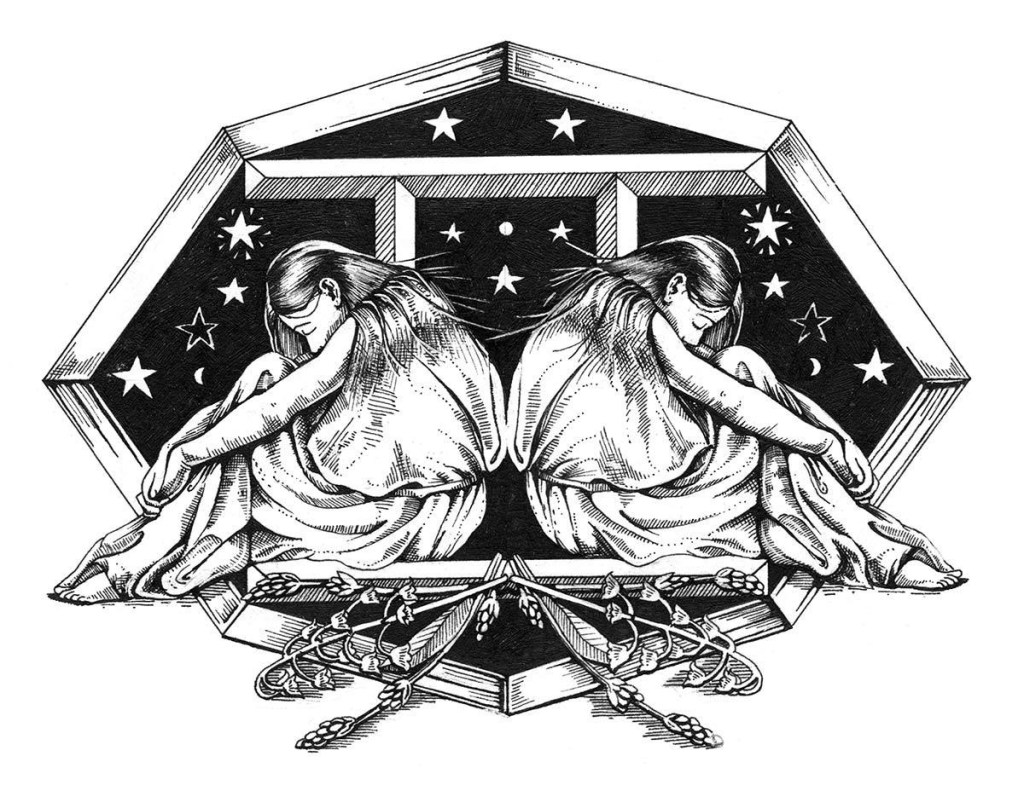
Gemini. A commission for ‘The Complete Astrologer’ by Derek and Julia Parker. 1981

I also explored my own realistic and abstract artwork and crafts, sculpture, clothes design, generally with a nature or recycling theme. Artwork was my healing journey from a childhood bereft of emotional comfort.

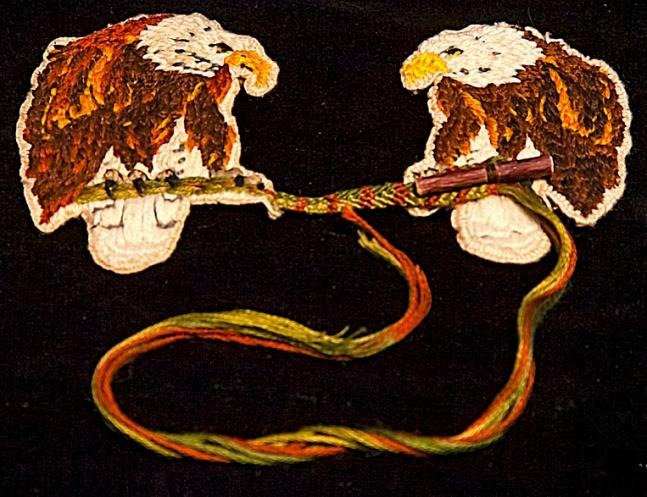
Embroidery eagles for a shirt collar. 1981

My work got bigger and bigger in size as my confidence grew.

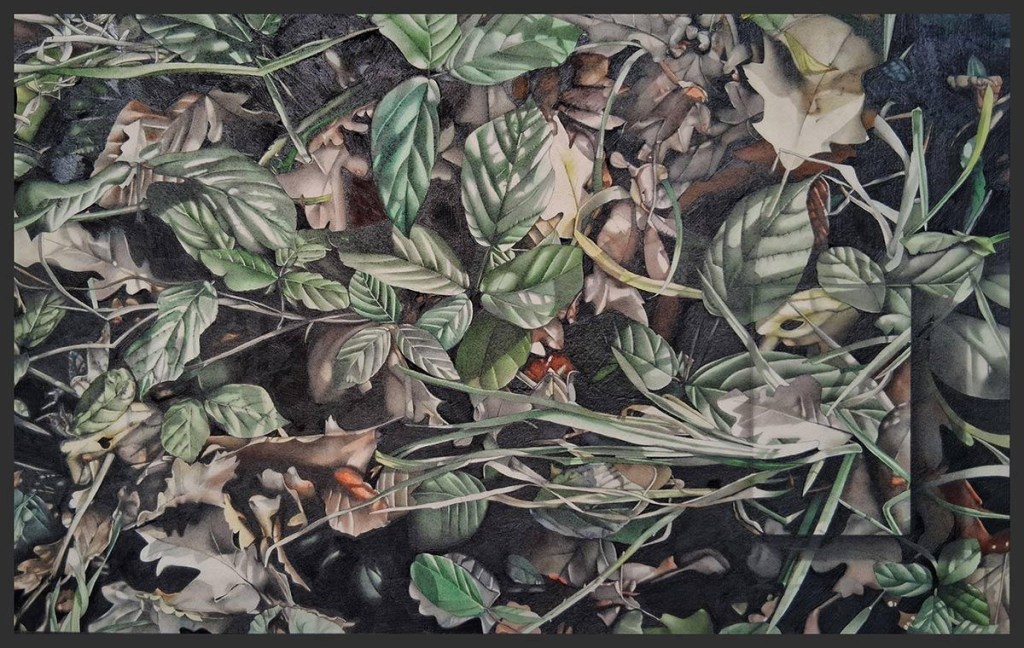
‘Blue Grass’ 1981 pencil and watercolour on paper.


In 1982, when I was 23 I had a motorbike accident and broke my leg in three places. The woman I was living with, Yvette was on the back and thankfully only bruised her knee. It was a complex fracture and they couldn’t operate immediately as I had friction burns on my leg. I found myself in traction, (they put a pin through the ankle and dangle a weight from it to pull apart the bones so they can realign them. Sounds like torture and it was!). Obviously some nurses and doctors were considerate but my experience of doctors standing at the end of my bed with their white coats on and clipboards talking about my condition without including me, stuck with me. Also asking a nurse for a bedpan and being told it wasn’t time for the bedpan round and I must wait. These were just two examples of emotionally unsafe behaviours that stayed with me for a long time. It was frightening. 

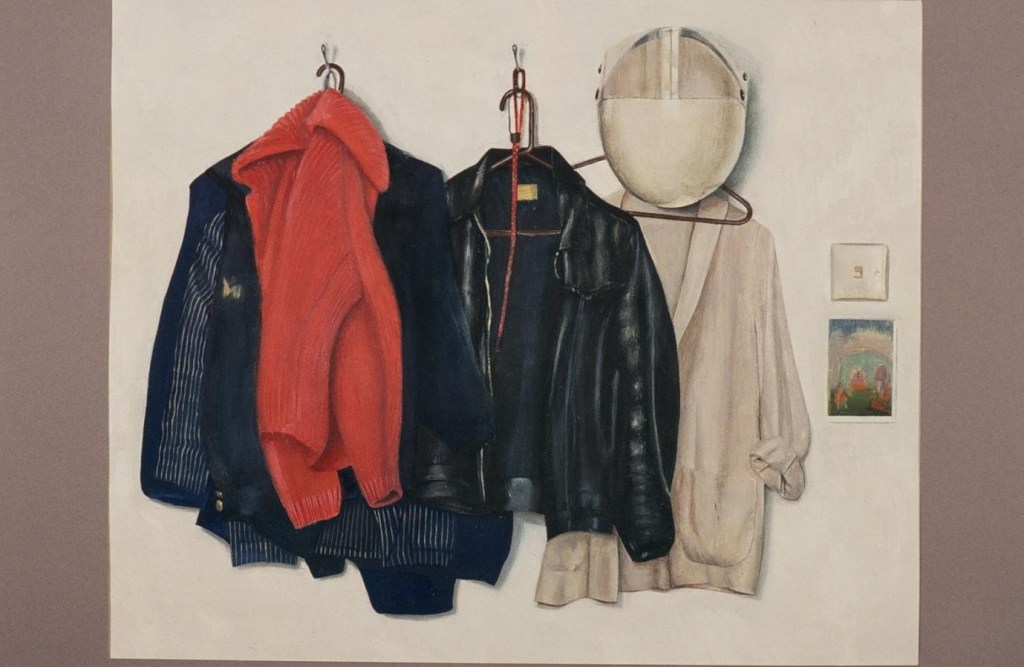
 ‘The Resting Biker’ 1982 oil on paper

Yvette came to visit me every day and when I came out of hospital I vowed I would never see a doctor again as I had felt so out of control. It was another pivotal moment where I began unconsciously building my need for complete autonomy and to find a healing space. The accident completely woke me up. I wanted a more spiritual life and I started to explore complementary medicine, diet and fasting to improve my physical health. 

I met Simo and Checca, the Italian twins at the women’s bathing pond at Hampstead Heath. Yvette moved out and they came to live with me. They had been brought up in rural Italy and moved to London when they were 11. They had gone to school at the famous Summerhill and were very open minded. They were outgoing sannyasins, disciples of Osho, an Indian Guru and I loved living with them. Through Osho, I learned about meditation, mysticism and spirituality. It was comforting and life affirming. Seeing life through the perspective of spirituality created a positive outlook. I also found a book called “You can heal your life” by Louise Hay and read it over and over. Its basic principle is “you are in control of your mind; it is not in control of you” and she provides exercises to let go of past painful conditioning and find that empowering place of being in control. She is also the queen of positive affirmations. 

Simo, Checca and I visited Italy for months and I loved it there. They both also knew about wholefoods and introduced me to cooking brown rice.

In 1987, when I was 28, I was having a conversation with my friend Roger and someone I had just met. This person asked me what I did for a living. I avoided the question and mumbled something about crafts. Roger said ‘she’s an artist!’ That was the first time I began to give myself that title.

That same year, Checca and I went to live in Italy. This created the real foundation for my connection with nature. My first activity was to collect figs from a tree and eat them, I loved it and it made complete sense to me. We collected and cracked pine nuts on a stone and made pesto with fresh basil. We stayed with Checca’s dad for a while. He was an accomplished artist. He foraged, including mushrooms.

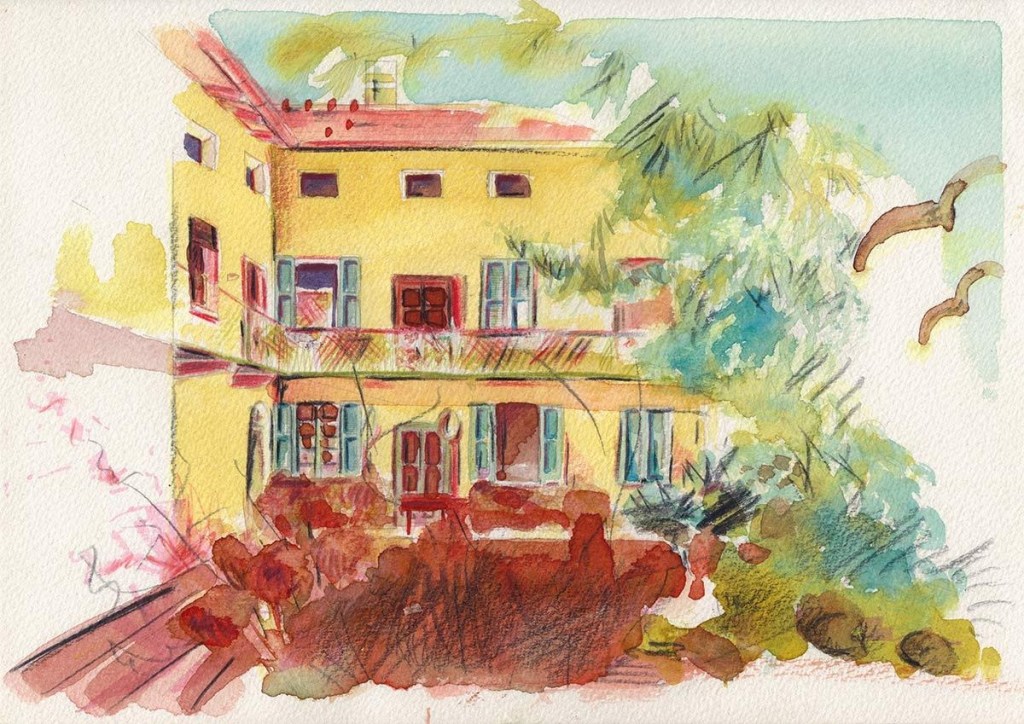
‘Antonio’s Garden’ 1990 ink on paper.(Checca’s dad’s house)

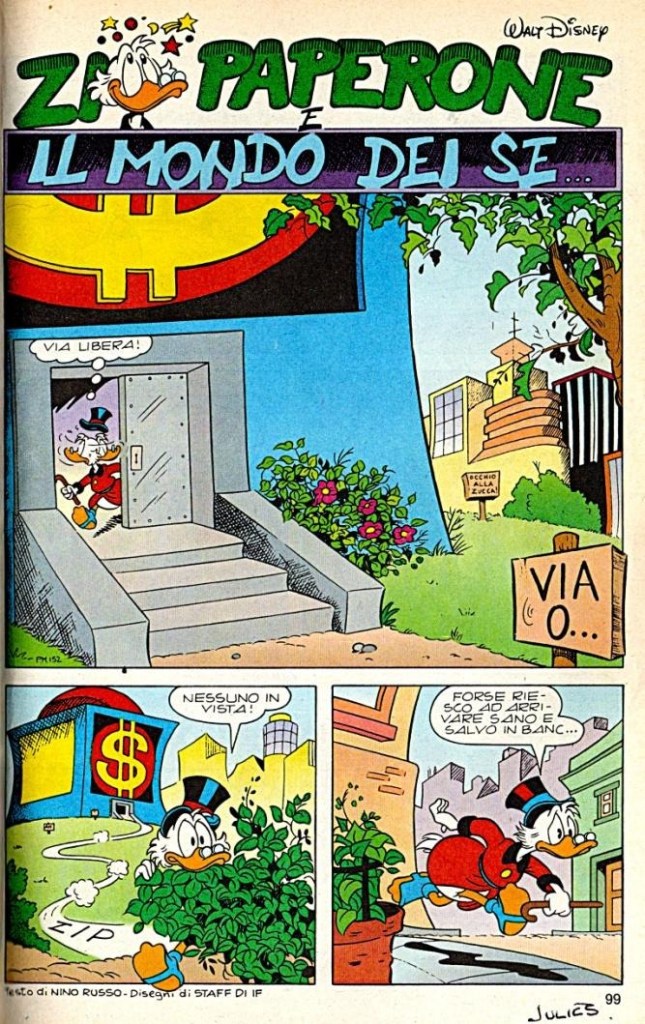
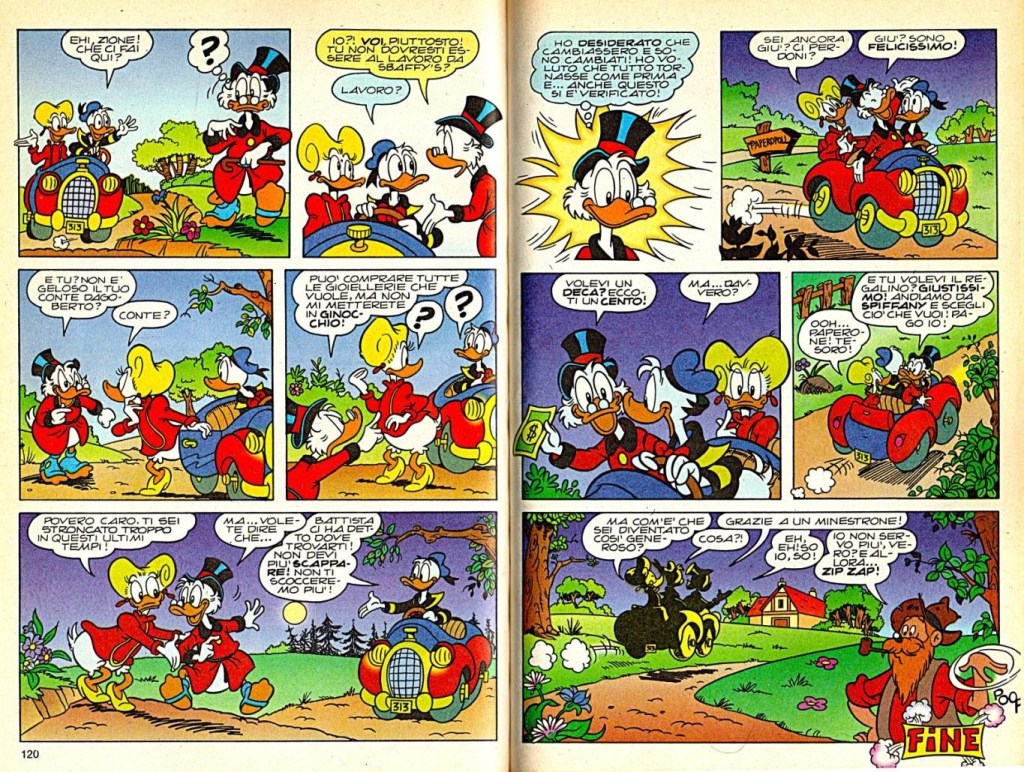
After almost a year with Checca’s dad and also staying at our friend Roberto’s house, we found a house to live in at the edge of a quiet village in the countryside. I meditated, (working on my inner demons of depression) and got a job working for Walt Disney drawing cartoons of Donald Duck for ‘Paperino Mese’. I would work at home during the week and go to Milan on Saturdays to the Walt Disney Studio to have my work assessed.

My drawings for ‘Paperino Mese’ 1991

In 1990, when I was 31, I came back to the flat in London which had been kept on by Simo. Checca stayed in Italy, Simo moved out of the flat and I lived there on my own. 

As I was healing, the eighth floor of a noisy tower block next to a main road with noisy neighbours all round me and no sound insulation, became a place of deep suffering. I could even hear my neighbour Tracey downstairs sweeping the floor. The sound of Tracey’s bass-heavy music in the night for two years and environmental health being unable to catch her brought me to a nervous breakdown, a catharsis, in 1998 and I was sent to a psychiatric hospital for a week. I then spent further spells in crisis centres and took anti-depressants until one day during a massage at the crisis centre, I broke down and exclaimed to the masseuse, “I’ve lost my soul”. I stopped the anti-depressants immediately.

The outer issue was always noise. The noise that humans create which, to me, made the sounds of nature harder and harder to hear. I longed for silence and the only sounds being the sounds of nature, I was obsessed with it. I felt breathless without it. I told a carer in the crisis centre that I longed to hear the sound of the birds and she said “well, we’ve got a birdsong tape!” I could have screamed; she didn’t get it. I wanted to be so immersed in nature that there was no separation. Birdsong on a tape was just another human invention and all part of my disconnected environmental crisis. I wanted the real thing, but I was on the dole, DHSS (Department of Health and Social Security) feeling ashamed and guilty. My friend Prabhu helped when he said, ‘Don’t feel guilty, it’s DHSS—Divine Help for Spiritual Seekers!`. I was living on £50 a week, no money in the bank and living, ‘existing’ in a noisy tower block in London. Sometimes I sat on my balcony at the flat with my hands over my ears, rocking from the insanity of the noise; traffic, household noises from uninsulated flats, police sirens, fire engines…and nature seemingly so far away out of my reach. My solace was to walk through Alexandra Palace park to Crouch End to buy my shopping from the health food store. Alexandra Palace was a walk across a little park next to my allotment and over the railway bridge. I also started to see counsellors and this gave me a feeling of strength and security. However, I couldn’t get out of the flat. No-one wanted to home swap to a tower block, I was trapped.

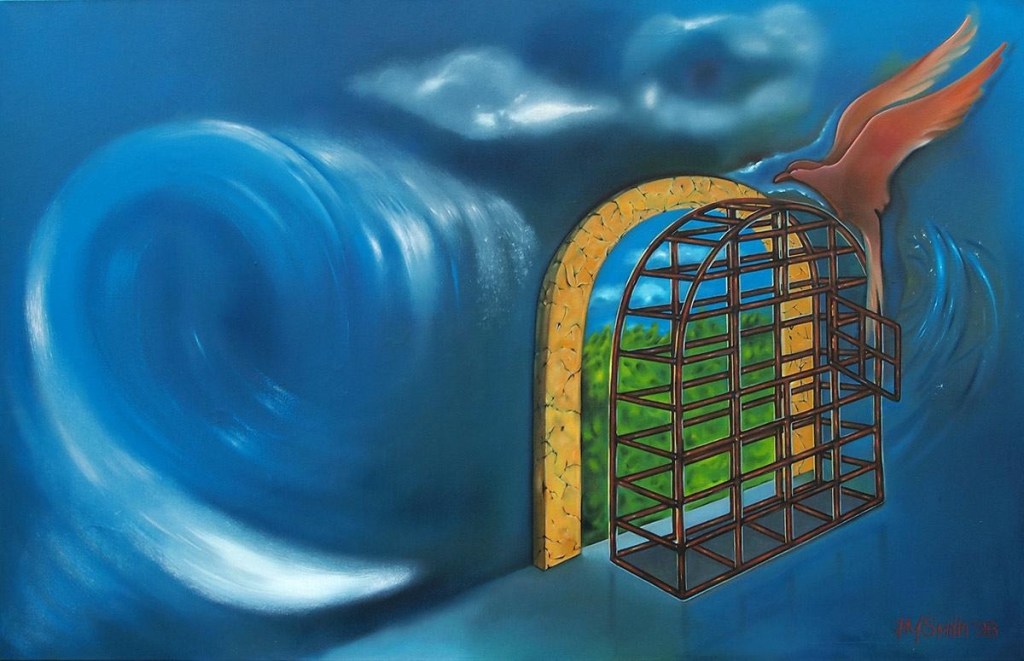
 ‘A Fine Line’ 1998 oil on canvas

I was continuously burdened with the thoughts of how to raise enough money as an artist to get a mortgage and buy my own place. It was a crazy idea, I was an Artist! Money was an alien concept, and consistently making money without feeling utterly stressed was even more alien. I had been on and off the dole for years, coming off to do a few months of freelance work and then signing back on again. I couldn’t cope with the pressure of relentless work; it sucked the joy and the purpose out of making art. Thinking only of the conventional route clearly wasn’t for me, but what was the solution?

I spent the next few years going in and out of the crisis centre, figuring out in my mind, what I wanted. On one visit, I met a man who did photography. He showed me one of his pictures. It was a barge going through a tunnel and there was a small bright light at the end. It made me ask, “What is my light at the end of the tunnel?” and my first thought was “America”! So I made that a goal. Unbeknownst to me at the time, my trip to America was to be another foundation for my deep inner craving for a more natural life.

AI Tomorrows, DIARIES & MEMOIRS: COUNTRIES A-Z, FLASH!, Many feminisms, Reflections, South Korea

The Woman Not on Any List

by Jo Eunyoung (South Korea, poet); see also Meet Me at Three O’clock at the LerDevagar Bookstore and The Summer We Once Wanted

*******

“Noblesse Matchmaking — we find you the partner you deserve.“

Even past forty, matchmaking agencies still send me messages. Maybe I’m still on their list of women who haven’t — or couldn’t — marry. Maybe it’s just an automated system firing into the void. Either way, I feel two things at once: a small admiration for their persistence, and a faint irritation at still being considered a target. I never delete the messages immediately. I leave them there for hours, as if one day even this might begin to feel urgent.

One day, a younger colleague leaned in close, as if sharing classified information. “Unni, I actually met my husband through a matchmaking agency (gyeolhon jeongbo hoesa: Korea’s paid marriage brokerage service that scores and ranks members by age, education, income, and appearance). You should try it too — I worked really hard at it.” She believed she was doing me a favor. The story of their fated, romantic meeting had apparently been constructed overnight — a tidy narrative designed to erase the fact that it had started with a checklist.

It’s not that I never tried. I dated steadily, loved recklessly. I was a bitch to some and an angel to others, just as certain exes were to me. I broke up and started over, again and again, and somewhere in that repetition, time slipped away — “hulsseok”(the sound Koreans make while swallowing tears).

People offered what they called gentle advice. You studied too long. You were too focused on work. They followed this with their own marriage success stories. A question rose in my throat — so are you actually happy?— but I swallowed it every time. I didn’t want to come across as the bitter unmarried woman, sneering at other people’s choices.

What they said always sounded less like advice and more like self-reassurance: that raising children is nobler than any career, that some men feel burdened by women who think too much, that love is fine but marriage is reality. I listened and nodded. You’re doing so well. I’m honestly envious. It was the kindest thing I could offer.

They say marriage is a choice now. But most people I know — born, like me, in the 1980s — didn’t quite choose it or reject it. They simply married, the way you do things when that’s just what’s done. A small number of us didn’t. Not entirely by choice, but not entirely by accident either. I live in the gap between those two worlds, and sometimes it’s hard to breathe.

I had actually joined that agency years earlier. Even then, in my mid-thirties, I was categorized as high-risk — too old for safe childbirth, too educated to be appealing. My PhD was a liability, they said; men worried I might correct them. They suggested I list only my bachelor’s degree. Still, they found reasons for optimism: I looked younger than my age, I wasn’t overweight, and my voice was soft and pleasant.

Suddenly I was a product approaching its expiration date. A new agency promised AI-based matching, as if intimacy were a logistics problem. When I saw the ad, I thought: I’ve walked into the wrong place entirely.

This isn’t where I belong. Run.

An unmarried woman in her forties. Neither young nor old. Studying literature. On television, forty-something single women are always successful — corner offices and sleek apartments. The term gold miss (a glamorous, financially independent single woman) comes from that image.

But I can’t claim the gold. My degree didn’t translate into salary. I spend my nights revising poems, asking myself: will I ever publish a collection? Will I become the poet I want to be? I am, by most measures, badly out of step with this era.

I can’t join my friends’ conversations about stocks, real estate, their children’s tutoring costs, the latest housing policy. I’ve grown a little strange, just as they predicted. The future still frightens me, but I’ve stopped chasing someone to make that fear quieter. That’s left me lonelier in some ways.

I’ve also stopped obsessing over my weight. I prefer streets with trees to streets with people. I’ve started to understand why middle-aged people photograph flowers. I have no children, but I tend my writing with the same careful attention — softly, gently — and I love it deeply. I take care of myself. I protect my small world.

Then I heard that younger Koreans had coined a term for people like me: yeong-poti (Young Forty: started as a compliment for energetic forty-somethings, now a slur for those who refuse to act their age). I checked myself against the criteria. I don’t wear streetwear brands. I have no money to spend chasing younger company. I didn’t buy property cheaply and profit from rising prices. I wasn’t even pretending to be young. I’ve just never quite grown up, if I’m honest.

In the marriage market: not on the list. Among the targets of generational contempt: not on that list either. Nowhere do I fit neatly into the available categories. For a while, I shrank under the weight of that. The world says it has changed — women’s rights, feminism, marriage as personal choice. In some ways, yes. But I still have one foot in a world that sees my life as a problem, and one foot in a world that has no name for what I am. Too hot, too cold. I move between them, belonging fully to neither.

I live alone. I cook for myself. I write. I handle each poem the way you’d handle something you love — carefully, then carelessly, fighting with it, making up with it, coming back to it again. Sometimes someone looks me in the eyes first, and there is warmth. Not fire, but warmth. Somewhere between the cold bath and the hot one, in that lukewarm in-between place — that’s where I am.

DIARIES & MEMOIRS: COUNTRIES A-Z, Exclusive to COTW, India, Scotland

Body Maps

By Sreenithi

I loved walking through Edinburgh Old Town, up and down the Mile from crag to castle. I loved walking through Holyrood Park and sitting by the lake. It was called St Margaret’s Loch, and you could spot an entire fleet of swans on the water, looking stately and proud. I was terrified of them though. At close range, you could really see why birds are the last living dinosaurs. But I digress.

Having lived most of my life in the busy, metropolitan Bangalore, I was not used to the idea of walkable cities. Perhaps that is a uniquely European indulgence, making it a great tourist selling point. Bangalore is too big…and too chaotic to be walkable. Need I even mention the hellscape of road traffic that could easily consume your daily commute? 

It wasn’t as though I was out and about every day. Much to my shame, I barely knew my way around my hometown. I mostly stayed indoors, sitting and stewing in my own thoughts and dysfunction. Suspended in grief for over ten years without even realizing it, there was no real sense of normalcy. My family was paralysed too, frozen, and barely getting through each day. I hated being at home, but I struggled to get away.

I didn’t go out for walks. I didn’t learn how to ride a scooty or bike like the other kids to give myself that independence. I didn’t join extra-curriculars or explore sports. The only way I managed to prolong my ‘outside time’ was to hang out with my friends after class. But not for too long, because then I would have to worry about getting back home late, relying solely on unreliable public transport or a known auto uncle from my neighbourhood. Sometimes if I was lucky, a friend would drop me home on his bike.

The thing was, I wanted to get away from home, but I hated going outside. Because I hated myself. I hated my face and my body and my hair and my clothes. I wanted so badly to be seen but I didn’t want to be perceived. But there was something more insidious: I was stuck in debilitating survival mode. The poor city planning and waste management, the collective disregard for traffic rules, the noise and pollution, the fragile bubble of safety (if you’re a girl) – all these were navigable if you had the resourcefulness and a can-do attitude. ‘India is not for beginners’ as the meme goes. You just learn to deal with it as you go, to embody the chaos yourself.

But I was too incapacitated. Too broken and grief-stricken to be a proactive go-getter. Which is why moving countries for my master’s degree was quite a seismic shift. It meant that movement was no longer optional. But it was also no longer hindered. The easy, serene, walkable streets of Edinburgh were an essential scaffolding to get me out of my own head. For the first time in my life, I was going outside on my own terms…every single day. And I loved it! 

Edinburgh was so beautiful to experience. I couldn’t get enough of it. I learned everything I could about this quaint, historic little city. The closes and wynds, the undulating lanes, the view of the hills, the faint speck of sea in the distance, and the perpetual grey sky, all these became etched in my mind’s eye. This was the right place for me – not too big to overwhelm, not too small to suffocate. It was the perfect size to hold fully in my heart. It was the first place that I fell in love with, the first that I chose as home.

But for whatever reason, my journey there was constantly turbulent. For one, I moved house over eight times in a span of just three years. Not to sound too superstitious, but it felt like the city would simply not let me settle. ‘You will not find success here,’ someone at a party said to me once as she did all of our horoscopes. Not too long before that, my childhood grief had burst out of me, delaying my career and jump-starting the healing process rather violently. 

My first job was terrible. I felt so poorly treated that I quit in just four months and I have been unemployed ever since. Perhaps I shouldn’t have visited the castle at the start of my course. But how could I have known? Nobody told me it was bad luck to go there before graduating. There were days when I walked down the streets, sat in buses and parks, crying bitterly, baring my ugly tears to the city. There was even a time when I broke down inside a church, and I am not the religious kind. But things only got progressively worse. It was part of the recovery, but it left me so hollow.

And yet I loved this city to bits. Vehemently. The thought of leaving was agonising. 

‘Why do you even want to stay when this place is not serving you?’ a friend asked me.

‘Maybe you’re not meant to be here, maybe something better is coming,’ said another.

I was told well-intentioned things like this all the time as I resisted the prospect of leaving. How could I even begin to explain that it was as simple as wanting to walk up and down the streets? Not any street, but Edinburgh streets, and the closes, because they had become the rugged topography of my newfound agency. How could I explain that it was as simple as loving the old, gothic buildings and the sound of bagpipes sneaking up on me from around the tourist-heavy corner?

I didn’t just fall in love with the fantasy of this city, I loved it to its bones and grimy underbelly (yes, the Fringe venue too). Sometimes I close my eyes, and I can see it all so clearly. Vivid little snapshots, as though I never left. Usually, it is a flash of the road starting outside Waverly mall, sloping down to meet the small intersection on Market Street before opening into Cockburn Street and curving upwards. I don’t know why this is the chosen snapshot. But then I open my eyes again, and it is like I was never even there. Like a faint afterimage from another time and consciousness.

I am now in the Netherlands, trapped once again inside a visa deadline which is fast approaching. The city planning here is even more impressive. It is brighter, nicer, and the Dutch surely love their flowers. Perhaps I learned to contain my attachments. Or it is just a natural consequence of growing older. But I don’t feel the same magic. I like Holland but the experience has been somewhat flat (no pun intended). Could it be that I am more well-adjusted now? Or too numb?

But how nice it is to be here! The clean air and the easy, walkable roads. This permission to exist so naturally and freely in public space, something I cannot quite experience in Bangalore. At least not without effort and privilege. Sometimes, it really is as simple as wanting to hold onto the material comfort of a place. Don’t fault a migrant for their superficial goals, I guess.

I miss Edinburgh Old Town and Holyrood Park. 

I miss the agency that warmed my legs as I walked back to my flat, late, on a cold winter night.

I miss the person that I used to be walking up and down those hilly streets.

It was a place where I felt like myself.

It was home.