Canada, Exclusive to COTW, Reflections

About shame

Submitted to COTW anonymously from QC, Canada; translated from the French using ChatGPT

Shame is the emotion associated with the feeling of being inadequate, defective, or unworthy of belonging to the group. A painful, even debilitating emotion, it is fundamentally social in nature. From as early as age 3–5, it brands with a hot iron the behaviors deemed socially reprehensible. It is the ultimate physiological punishment for having “acted wrongly.” The sentence: exclusion from the group and the anticipated loss of one’s humanity. For the nervous system of a social animal, exile is death. Shame, therefore, is the feeling of imminent death. No wonder we constantly pass it around like a hot potato — both a source of power when imposed on others (symbolic murder) and a source of deep suffering when endured ourselves (living is killing me).

The physical consequence of shame is the inhibition of the motor system, the protection of internal organs (shoulders curving inward), and a painful tightening in the chest or stomach. The internal message is: if I keep acting, I will die. In its primary function, shame is essential to social regulation. It is likely the first regulator of our instinctive violence. We will all experience shame many times throughout our lives. As long as it is felt occasionally, in response to deviant, violent, or destructive behaviors, it is an emotion that has its place in the normal conditioning of human beings.

Shame becomes problematic when it is experienced systematically, with no symbolic possibility of correction, repair, or lasting return to inclusion. When one endures shame continuously, one ends up living in a state of constant chronic stress. Cortisol, at high doses and for long periods of time, becomes neurotoxic. Executive functions diminish, as does our capacity to self-regulate and return to a “rest and digest” state. In some cases, it kills. At best, it generates trauma.

As with any stressor, the nervous system will typically seek a fight-or-flight response to cope. When physical escape from the shame-generating environment is impossible — or when shame has become internalized and follows us wherever we go — two other options arise: chemical regulation (drugs) and/or dissociation (inhibition of the circuits associated with pain and emotion). On the “fight” side, it is generally through contempt or violence that one seeks to silence shame. Contempt is the psychological belittling of the person generating shame — in other words, the externalization of shame: It’s not me who should be ashamed — it’s you. Violence is the desire to subjugate, psychologically or physically, the perceived source of one’s shame: If you disappear, I will no longer feel ashamed. All of these strategies temporarily dispel the feeling of shame, but if the source of shame is not addressed and resolved, the pendulum almost inevitably swings back.

This duality of shame and contempt/violence may be at the root of the worst facets of human experience. It is a self-fueling pendulum, naturally and indefinitely oscillating between one state and the other, as long as the underlying issue — internal or external — remains unresolved. When two shame-carrying individuals live in close proximity, their pendulums tend to synchronize.

Sometimes the pendulum stays in relative equilibrium, sometimes for many years, with each party managing to counteract the other’s contempt in a roughly symmetrical way. These are painful, loveless partnerships, but relatively functional ones — not without their good moments, between each swing of the pendulum, when both parties find themselves at a standstill.

One day, however, in such dynamics, a vulnerability appears: one party cracks, asks for forgiveness, and promises to change. The pendulum, established over years, will not stop for that. This time, contempt will meet vulnerability, driving a little deeper with each swing. Contempt — the antithesis of shame, or rather, externalized shame — is strangely addictive. It confers a sense of power on the one who expresses it. Left unchecked, it tends to grow, naturally escalating into violence.

Eventually, the party in the weaker position within this dynamic will seek to flee, appease, or retaliate. Flight, without external support, will not always be possible, or at least not immediately. Flight also means the unknown. Letting go of familiar bearings, even unhealthy ones, is always a painful experience. Appeasement works in the short term, calming the aggressor’s impulses, but at the same time, by avoiding conflict, legitimizes them. Retaliation, costly in energy, becomes increasingly difficult as the victim’s resources are depleted. The experience of violence, and the shame that follows from it, is inherently incapacitating and traumatic.

It is generally through a combination of these strategies that the victimized party manages to extract themselves from the dynamic. If sufficient distance is achieved and an adequate support network exists, and with appropriate psychological help, each party’s pendulum will gradually return to equilibrium.

In the absence of such a support network or sufficient distance, the dynamic will not stop. The violent party, convinced of their superiority and frustrated at not being able to exploit the dynamic for longer, will want more. Violence, and the sense of power it produces, is addictive. If they can no longer reach the victimized party in their immediate environment, they will do so through that person’s social circle —spreading rumors, rallying as many people as possible to their cause, positioning themselves as the victim. The violence becomes communal.

In a healthy community, mechanisms would exist to regulate such processes. The victimized party could draw from their social circle the additional strength needed to provide adequate counterweight to the violent party. The violent party would be brought back into balance by their own circle, or threatened with sanctions. Eventually, if the damage was relatively superficial, after both parties had stabilized, a process of mutual understanding — and perhaps even repair — could be envisioned.

Unfortunately, we do not live in healthy communities, but in a social environment that perpetuates violence and shame across the full breadth of human experience — domestic, geographic, and in working relationships. We have become isolated, inhibited, selfish, and/or full of shame in relation with ourselves. It is no surprise that the far right, which makes its business out of channeling violence and contempt toward marginalized social groups, is flourishing in the current context. Behind the social mechanisms — capitalism, colonialism, patriarchy — that fuel this system, one constant remains: the human propensity to maintain or consolidate one’s status, and to flee from suffering. Dehumanizing the other is simply a means among many to achieve that end. To my knowledge, there is only one remedy to this psychological cancer: connection, community, and love. In the current social and economic environment, opportunities for these are fragile — but not nonexistent. They must be protected and carefully tended.
Ecology of the absurd, Exclusive to COTW

You can really do it!

“There is nothing either good or bad but thinking makes it so”, Shakespeare, Hamlet circa 1600
“The mind is its own place, and in itself can make a heaven of hell, a hell of heaven”, John Milton, Paradise Lost, 1667

Zeal is what you need! Get UP! Get unentranced! True, it is hell, but ride the diamond seams right through it, to where your grateful grand nieces will be waiting. Have an apple a day until there are none left, and then a handful of bitter berries a day, and find a new sweetness in that sharp taste.

Enough enough! I know I know, it worsens by the day, you do not need to tell me. Choose your own private bliss and hold steadfastly to it, do what work you can, enjoy the sunrise but more than ever the sunset and all that it is setting on.

I had a new student today. Just ten years old. He was not very communicative. He told me about his best friend. I asked him, why are you best friends? He replied, because I love him and he loves me. He reminded me that sometimes, love can be beautifully simple.

Zeal is what we need. Imagine the good we could do, even if it were just a few of us. There is zeal in ecology, the way it thrives and burns. But we have become lazy. Soon the Earth will force our hands, and we can thank God or Life at least for that.

DIARIES & MEMOIRS: COUNTRIES A-Z, England, Exclusive to COTW

How to ruin a man’s orgasm

By Eric Black

The physical techniques are well-known. There is a whole weird subculture online devoted to them. But I refer to the psychological and societal techniques. First, the man should be born into a liberal Western family, which retains just enough unconscious traditional expectation of high male performance as to confuse the young male mind, growing, as it would be, in a free-thinking family which claimed to be indifferent to gender roles. Second, the man should grow to be bisexual, but not to be too comfortable in his bisexuality. Third, his parents should divorce at a young age, with the father leaving the family and maintaining only brief fortnightly contact. Fourth, the man, as a teenager, should over-use alcohol, cannabis, and porn, should go to the wrong university, should leave early and not get a degree, should enter into homo-erotic friendships where neither side admitted the homo-eroticism and where the other guy would dominate the friendship, making it difficult for the man to socialize in a wide and balanced way; and should break up with his first girlfriend, painfully, after a couple of years. Fifth, the man should develop serious mental health problems in his early 20s, feeling like a failure, should make friends with people who later killed themselves, and should have all his prospects for making a living destroyed by peer pressure, the expectations of the university-uneducated and a persistent nagging low self-esteem. Sixth, the man should go through his 2os with no sexual contact with anyone, forcing his sexuality to become auto-erotic, exhausting his orgasms to the point of no return, almost breaking them. Seventh, the man should finally find a long-term partner, but whom he is ultimately not suited to and does not have regular sex with, ending in a protracted and tortuous break-up.

And yet, all this may not be quite enough to totally ruin a mans orgasm, because the man may marry a kind and understanding person, of whatever gender, who may help him to explore his sexuality, who may help him to recover his hardness, as well as his softness, who may support his critique of this abusive society, who may stay with him till the end.

Exclusive to COTW, FLASH!

Marabella, Hot and Cold

By Dan Nawaz

Chauncy Clemens was leaping through the bonfire when his dress went up. We were untouchable ‘til then. 

We, the Marabella Sarcophagi, danced and took bolt filtre in the ash-fed southern forest every week. Most of us were the children of second generation Pelivosi —so there was never a shortage of cash for our elaborate homemade robes, or for our filtre and booze, and I never felt guilty about taking it. 

As Chauncy burned nobody was screaming. We were grieving the end of a lovely time alone, ending before our eyes. He was ever strange to me. Stubborn —could never take no for an answer, that boy, and in truth I was glad of him going even as I watched in that moment. 

Bolt filtre made you optimistic though. Like fire blossoming inside you. So when I started hacking him apart the rest became relieved, even enthusiastic to join in. We took parts of Chauncy home and hid him in our bedrooms away from adult eyes. Others —who knows who— fed him to the dog and buried him in the park and ate him and pickled him and asked him what it was like being dead and being everywhere at once. He was only ever taken to the reaches of ourselves, barely out of school mostly, but knowing he had made it out of reach to some secret place beyond sight, many of them began to nurture a sickly envy for the dead boy. I knew it from their look, coming back to the forest parties. From their hushed conversation and red eyed stare.  

I learned some weeks later that some of the Sarcophagi had begun bringing their scraps of Chauncy to the dances. I caught Annie Gorbale talking into her hands and yanked her to the treeline. 

“Fuck’re you doing Annie?”

“Doing nothing.”

I slapped her curd of a cheek and she dropped him, a blackened thing like tree bark. 

“He said he wants to dance.”

“Quit your nonsense, you’re scaring the new kids.” 

“But it’s you he wants to dance with,” Annie said with her wet eyes and her butterfly gown, and picked up the charred lump I saw was wrapped in dark, stained gingham like a bridal favour. The air was thick and I felt behind me the dance had slowed. I felt bodies breathing at my back, a whole crowd swaying together. Their presence thrummed as a group of many but more keenly as a single glaring and grave-sour scorn. They felt hot. Smelled like him too, like sour chocolate milk. Not my Sarcophagi anymore. Chauncy’s.

So, we danced. And when Chauncy wanted to kiss we kissed, and I tasted him distilled. And after, when I could breathe again and I was allowed to be scared properly I found myself carrying him still, even in my room, still kissing him when we were alone like he’d always wanted of me.

And it was like playing. Guessing how I might die each time, and when I guessed right at last, just laughing. It was the funniest thing. Laughing together because even Chauncy, even now, he didn’t know himself how it all happened or whatever was coming next. 

Outside the streets were dark and cold but dinner was waiting downstairs.

DIARIES & MEMOIRS: COUNTRIES A-Z, Ecology of the absurd, England, Exclusive to COTW

Building Silent Haven: Chapter Two

Featured image: ‘Lunchtime Concerts’ 1979; Pencil and collage on paper (College project)

When I left college in 1981, I was offered a council flat on the eighth floor of a tower block in Wood Green, London, so I took it. I had to go through seven doors and a lift to get out, but I didn’t think about it then, I was living in a totally ungrounded, drug-filled fantasy world, and so being in the air suited me. I imagined it as my high-rise apartment in New York. The famous artist. This is who I believed I wanted to become.  But I was extremely self-critical, not even knowing I was being so hard on myself. It had been a normal part of my childhood. This and my lack of confidence kept me in a cycle of wanting to block this harshness out.

After 3 years at college, I had had enough of Graphics and began doing freelance illustration. I did commissions for The Magic Circle, BBC, Channel 4, The Fiction Magazine, Spare Rib, World Wildlife Fund, Live Aid and various publishers.  My work was small, black and white in ink or pencil, and it was detailed. 

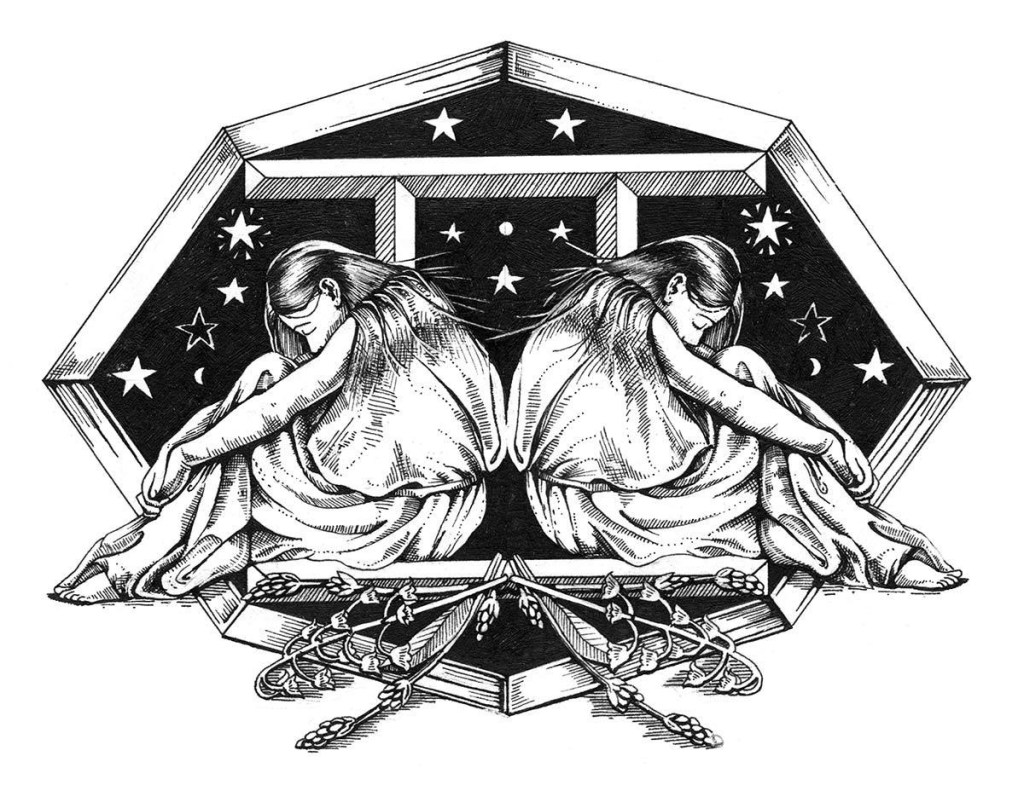
Gemini. A commission for ‘The Complete Astrologer’ by Derek and Julia Parker. 1981

I also explored my own realistic and abstract artwork and crafts, sculpture, clothes design, generally with a nature or recycling theme. Artwork was my healing journey from a childhood bereft of emotional comfort.

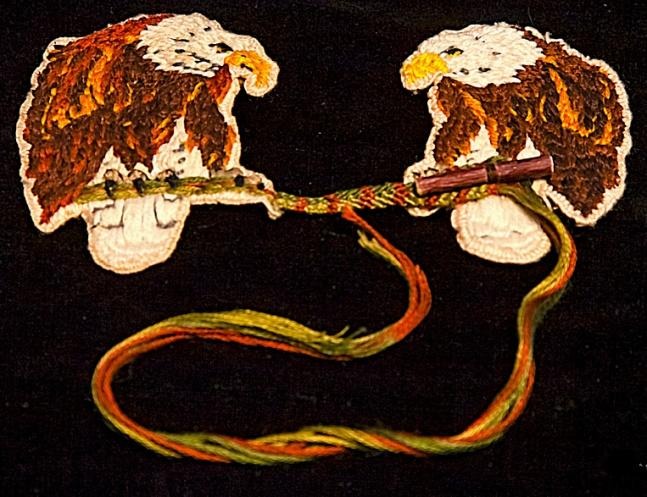
Embroidery eagles for a shirt collar. 1981

My work got bigger and bigger in size as my confidence grew.

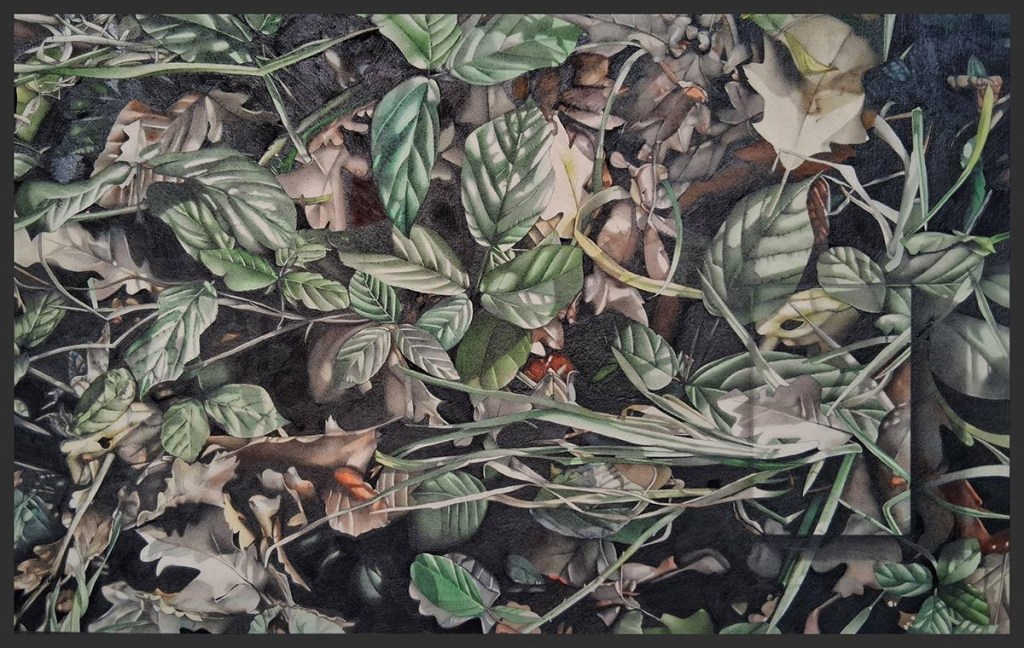
‘Blue Grass’ 1981 pencil and watercolour on paper.


In 1982, when I was 23 I had a motorbike accident and broke my leg in three places. The woman I was living with, Yvette was on the back and thankfully only bruised her knee. It was a complex fracture and they couldn’t operate immediately as I had friction burns on my leg. I found myself in traction, (they put a pin through the ankle and dangle a weight from it to pull apart the bones so they can realign them. Sounds like torture and it was!). Obviously some nurses and doctors were considerate but my experience of doctors standing at the end of my bed with their white coats on and clipboards talking about my condition without including me, stuck with me. Also asking a nurse for a bedpan and being told it wasn’t time for the bedpan round and I must wait. These were just two examples of emotionally unsafe behaviours that stayed with me for a long time. It was frightening. 

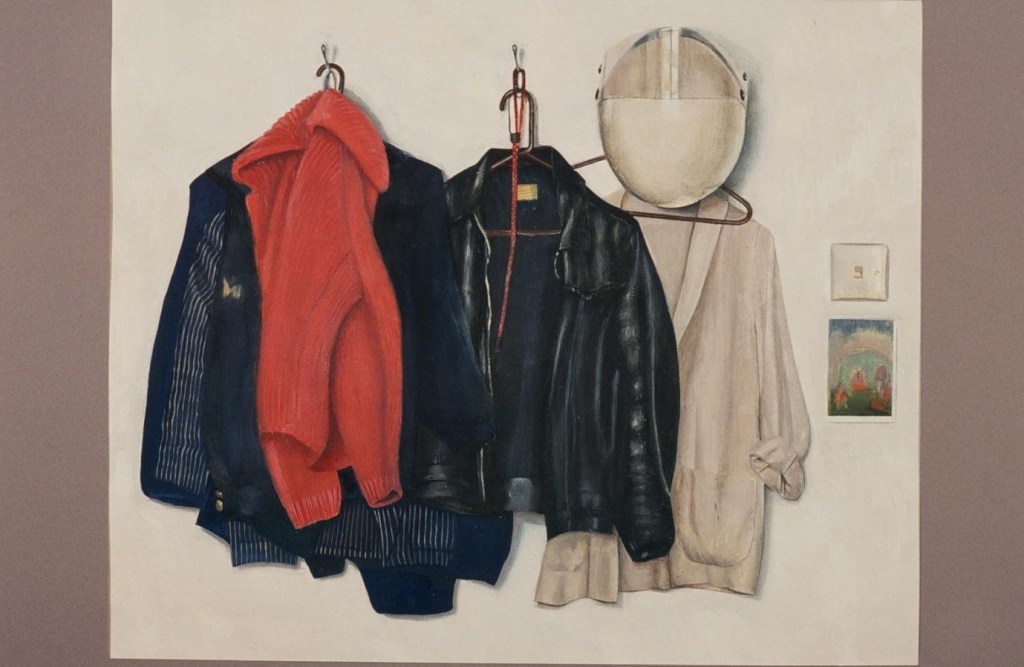
 ‘The Resting Biker’ 1982 oil on paper

Yvette came to visit me every day and when I came out of hospital I vowed I would never see a doctor again as I had felt so out of control. It was another pivotal moment where I began unconsciously building my need for complete autonomy and to find a healing space. The accident completely woke me up. I wanted a more spiritual life and I started to explore complementary medicine, diet and fasting to improve my physical health. 

I met Simo and Checca, the Italian twins at the women’s bathing pond at Hampstead Heath. Yvette moved out and they came to live with me. They had been brought up in rural Italy and moved to London when they were 11. They had gone to school at the famous Summerhill and were very open minded. They were outgoing sannyasins, disciples of Osho, an Indian Guru and I loved living with them. Through Osho, I learned about meditation, mysticism and spirituality. It was comforting and life affirming. Seeing life through the perspective of spirituality created a positive outlook. I also found a book called “You can heal your life” by Louise Hay and read it over and over. Its basic principle is “you are in control of your mind; it is not in control of you” and she provides exercises to let go of past painful conditioning and find that empowering place of being in control. She is also the queen of positive affirmations. 

Simo, Checca and I visited Italy for months and I loved it there. They both also knew about wholefoods and introduced me to cooking brown rice.

In 1987, when I was 28, I was having a conversation with my friend Roger and someone I had just met. This person asked me what I did for a living. I avoided the question and mumbled something about crafts. Roger said ‘she’s an artist!’ That was the first time I began to give myself that title.

That same year, Checca and I went to live in Italy. This created the real foundation for my connection with nature. My first activity was to collect figs from a tree and eat them, I loved it and it made complete sense to me. We collected and cracked pine nuts on a stone and made pesto with fresh basil. We stayed with Checca’s dad for a while. He was an accomplished artist. He foraged, including mushrooms.

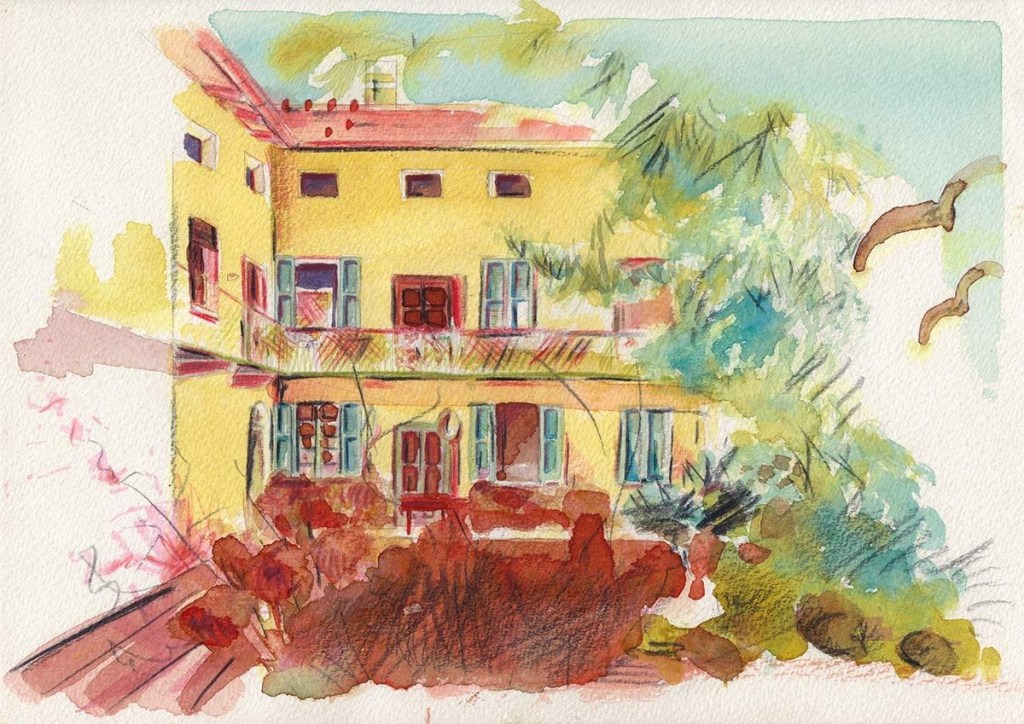
‘Antonio’s Garden’ 1990 ink on paper.(Checca’s dad’s house)

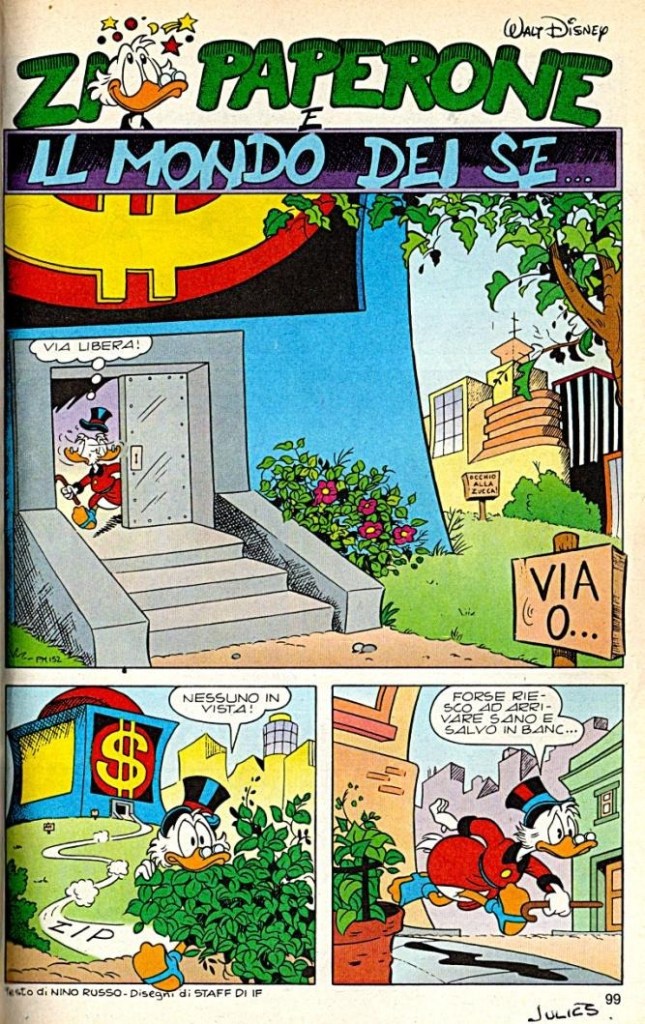
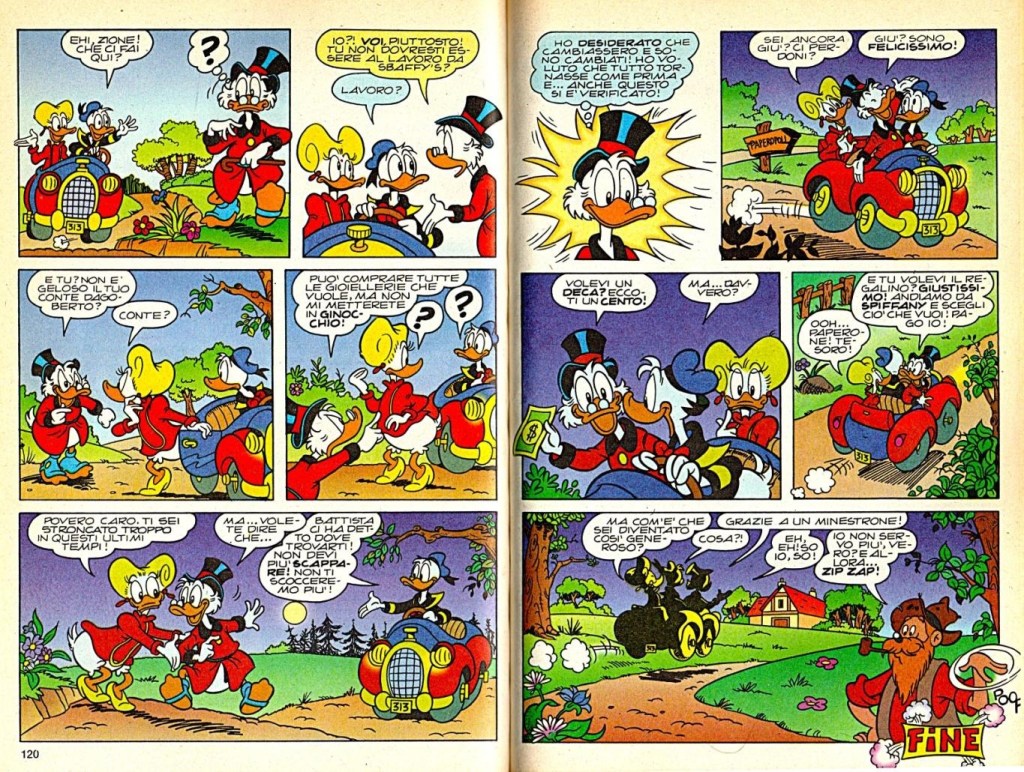
After almost a year with Checca’s dad and also staying at our friend Roberto’s house, we found a house to live in at the edge of a quiet village in the countryside. I meditated, (working on my inner demons of depression) and got a job working for Walt Disney drawing cartoons of Donald Duck for ‘Paperino Mese’. I would work at home during the week and go to Milan on Saturdays to the Walt Disney Studio to have my work assessed.

My drawings for ‘Paperino Mese’ 1991

In 1990, when I was 31, I came back to the flat in London which had been kept on by Simo. Checca stayed in Italy, Simo moved out of the flat and I lived there on my own. 

As I was healing, the eighth floor of a noisy tower block next to a main road with noisy neighbours all round me and no sound insulation, became a place of deep suffering. I could even hear my neighbour Tracey downstairs sweeping the floor. The sound of Tracey’s bass-heavy music in the night for two years and environmental health being unable to catch her brought me to a nervous breakdown, a catharsis, in 1998 and I was sent to a psychiatric hospital for a week. I then spent further spells in crisis centres and took anti-depressants until one day during a massage at the crisis centre, I broke down and exclaimed to the masseuse, “I’ve lost my soul”. I stopped the anti-depressants immediately.

The outer issue was always noise. The noise that humans create which, to me, made the sounds of nature harder and harder to hear. I longed for silence and the only sounds being the sounds of nature, I was obsessed with it. I felt breathless without it. I told a carer in the crisis centre that I longed to hear the sound of the birds and she said “well, we’ve got a birdsong tape!” I could have screamed; she didn’t get it. I wanted to be so immersed in nature that there was no separation. Birdsong on a tape was just another human invention and all part of my disconnected environmental crisis. I wanted the real thing, but I was on the dole, DHSS (Department of Health and Social Security) feeling ashamed and guilty. My friend Prabhu helped when he said, ‘Don’t feel guilty, it’s DHSS—Divine Help for Spiritual Seekers!`. I was living on £50 a week, no money in the bank and living, ‘existing’ in a noisy tower block in London. Sometimes I sat on my balcony at the flat with my hands over my ears, rocking from the insanity of the noise; traffic, household noises from uninsulated flats, police sirens, fire engines…and nature seemingly so far away out of my reach. My solace was to walk through Alexandra Palace park to Crouch End to buy my shopping from the health food store. Alexandra Palace was a walk across a little park next to my allotment and over the railway bridge. I also started to see counsellors and this gave me a feeling of strength and security. However, I couldn’t get out of the flat. No-one wanted to home swap to a tower block, I was trapped.

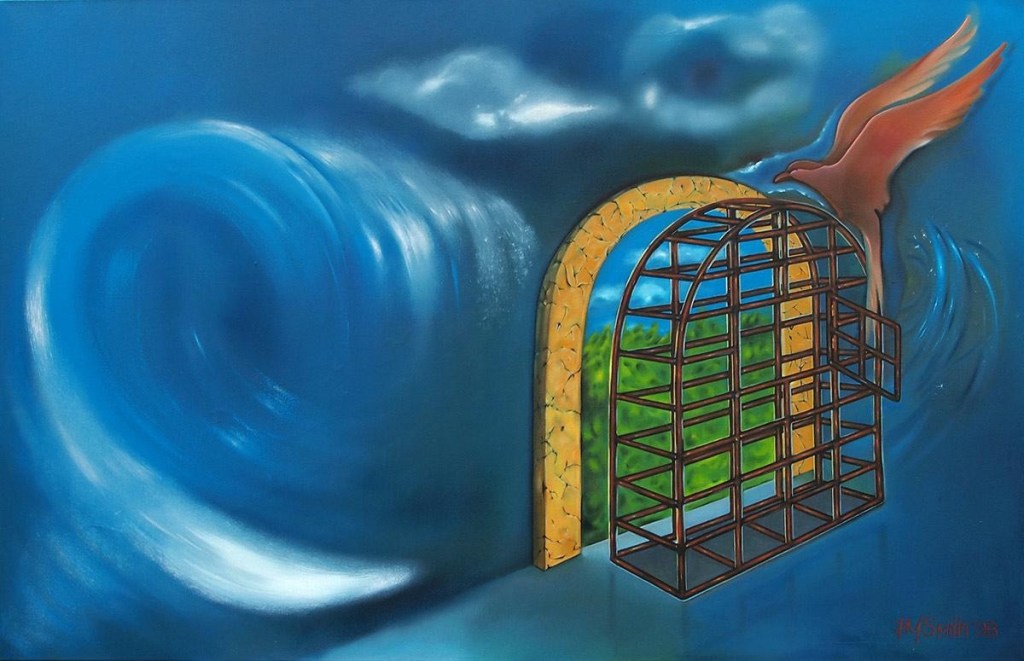
 ‘A Fine Line’ 1998 oil on canvas

I was continuously burdened with the thoughts of how to raise enough money as an artist to get a mortgage and buy my own place. It was a crazy idea, I was an Artist! Money was an alien concept, and consistently making money without feeling utterly stressed was even more alien. I had been on and off the dole for years, coming off to do a few months of freelance work and then signing back on again. I couldn’t cope with the pressure of relentless work; it sucked the joy and the purpose out of making art. Thinking only of the conventional route clearly wasn’t for me, but what was the solution?

I spent the next few years going in and out of the crisis centre, figuring out in my mind, what I wanted. On one visit, I met a man who did photography. He showed me one of his pictures. It was a barge going through a tunnel and there was a small bright light at the end. It made me ask, “What is my light at the end of the tunnel?” and my first thought was “America”! So I made that a goal. Unbeknownst to me at the time, my trip to America was to be another foundation for my deep inner craving for a more natural life.