
Back once again in London, I was still smoking cigarettes and marijuana and drinking alcohol. I had been suffering from migraines ever since the accident and knew these didn’t help but I was addicted. I desperately wanted a clean and natural life. In Italy I had read a book called ‘The easy way to stop smoking’ by Allan Carr. I had stopped smoking for about four months and then started again. So I decided to take one of his day workshops. A group of us were shown to ‘Parker Knoll’ recliner chairs with ashtrays next to them and we were allowed to smoke as much as we liked!. In the corner was a huge pile of empty cigarette packets. During the day, the group leader talked to us about what was hooking us into smoking and at the end of the day he gave me a business card and said “if you have any problems call me”. I left, passed a newsagent and thought “I’m not buying cigarettes tonight; I’ve just spent £140 on a workshop to stop!” So I didn’t smoke that night. When I woke in the morning I burst into tears. I remembered the group leader suggesting calling if there was a problem, so I did. He asked “What are you feeling?” For 28 years I had woken up and lit up a cigarette, wanting not to, and this morning I had woken up and not even had the desire to light a cigarette. “Relief!” I replied. I’ve never had a cigarette since and the marijuana and alcohol also dropped away and I’ve never had them since.
In 2003 I got an allotment at Ranelagh Road, which was across the road from my flat. I was 44. The allotment was a tiny haven away from the flat and my worries. I met Richard there; he had the allotment next to me and lived in a flat on the other side of Wood Green. Richard was extremely disassociated which was very painful for me. Suddenly he would disconnect from me. He mirrored my lack of self love. For example, I would make dinner for us and in the middle of a conversation; he would get up and walk out. I would try phoning him but he had switched off his phone. Sometimes he would not contact me for two weeks and then call as if nothing had happened. I found it excruciating. However, I was grateful to Richard as he gave me two major gifts, the first was my introduction to the art of looking at and mastering my thoughts and emotional responses and the second was a lightbulb moment which introduced me to the amazing freedom and reality of living and working on the land.
Richard had a big open allotment space and made very uniform raised beds. He planted Californian poppies, nasturtiums, and calendula as companions to his vegetables. Both nasturtium flowers and leaves are edible as are calendula petals. They make salads look beautiful. The vegetables were growing well as he fed the tomatoes with nettle tea and the broad beans and potatoes with ash. I was jealous, it looked beautiful. He was an artist. I felt competitive and threatened by his work. I would look at my allotment and criticise it. This was my usual painful reaction to other people’s creativity I admired.
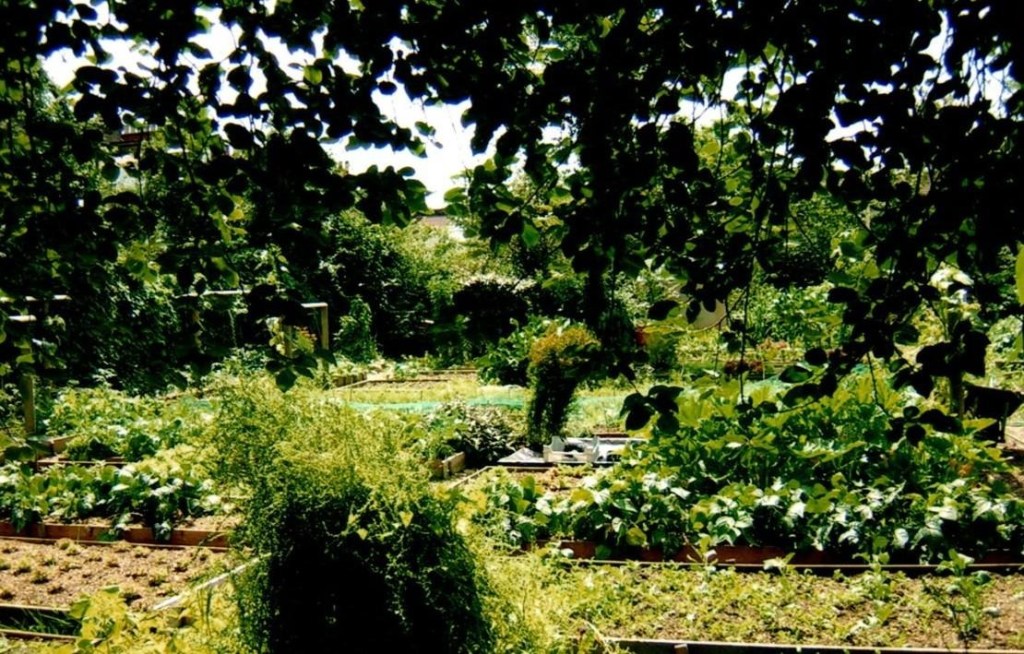
My allotment was the complete opposite; it was right at the back and under some huge trees, a shady woodland area.
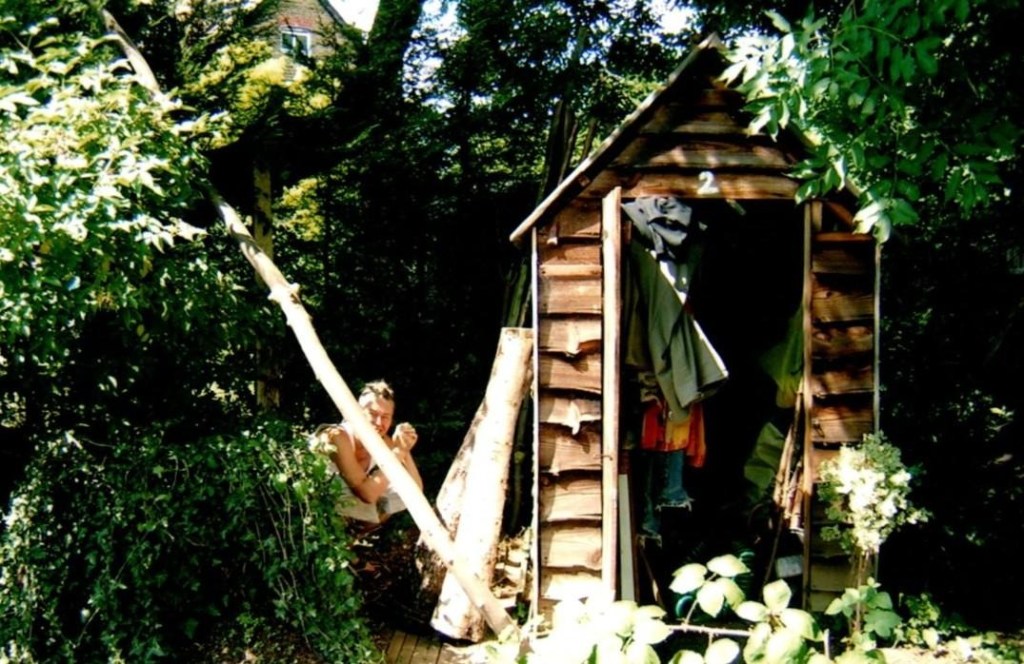
At first, I completely ignored its character and made a round bed in the middle and planted carrots. I had always wanted to grow carrots, pick them out of the ground and eat them straight away, so all the goodness was still in the vegetable. As soon as a vegetable or fruit is harvested it starts to lose its properties. It amazes me how people survive on food which has travelled many air miles.
The carrots didn’t grow. I began experimenting with vegetables which liked a bit of shade. I had limited success. Kale grew reasonably well but growing salad was hopeless. The shade made the area more damp which attracted more slugs, salad being a delicacy for them. I tried spinach, swede and leeks, also with limited success; my heart wasn’t really in it. By this time Richard was supplying me with veg he grew anyway. So, I gave up.
Richard never seemed to eat the vegetables he grew. He made a pond in the communal area, and I built a fire pit with some bricks, and he would go off to Wood Green, just around the corner and buy meat for himself and cook it on the fire. I’m a vegetarian. I don’t like killing animals, so I won’t eat them.
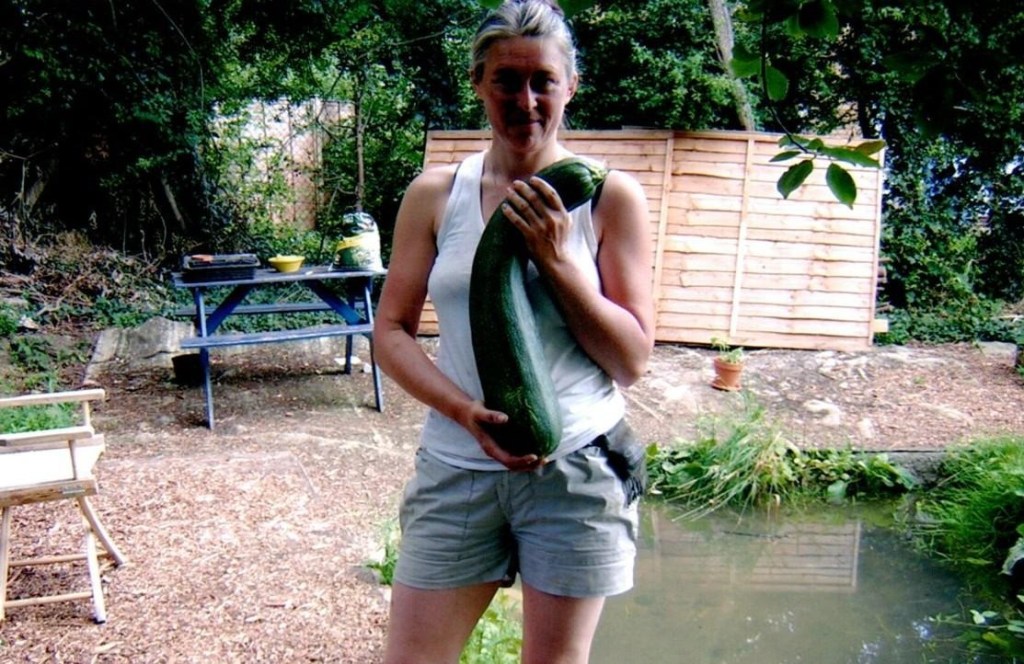
I became a frequent visitor to the local garden centre and usually couldn’t resist buying a plant or two. I wasn’t discerning, if it had pretty flowers, I would buy it. They rarely lasted. So, as with the veg, I started to look for flowers for shade. I became obsessed by which plants I could grow in my plot. I realised I was much happier with flowers than vegetables. I planted geranium, bluebells and wild garlic.
I would go from the flat when it was too noisy to the allotment, which also had an assortment of human noises, then to the studio, then when that was too much, back to the flat! That is how I managed my noise sensitivities. I was also constantly asking people to turn down their music, which sometimes worked and sometimes got negative comments. I felt permanently unsafe.
In the summer of 2003 Richard introduced me to Wwoofing (Willing Workers on Organic Farms). Farms and smallholdings write about themselves in a booklet and Wwoofers choose places to stay. The host gives us a bed, food and teaches us about the land and growing. In return, we work (generally 7-8 hours a day) Our first host was Alison. Alison and her husband Tristy built their own amazing house and planted a 5-acre woodland in Cornwall. I was so impressed. They had lived in a caravan and built from the ground upwards. She advertised free breaks for Wwoofers and we stayed there for a week without having to do any work! They were philanthropic, kind and eternally generous people. Richard and I stayed in their tiny hut in the woodland which had a cooker, a bed and a chair in it. I loved it. I was struck by a note Alison wrote in the hut which said, “Please do not cut down any leaf or branch from this woodland”. I loved this sensitivity and honour towards the trees. Alison and I connected, and she and Tristy became my friends. The kindness of her offering free breaks was only the first in a long line of future kindnesses which, quite frankly, literally saved my life.
Subsequently, whenever I broke down from the noise or fear of living an unnatural life in London, I would ring Alison. I would often say I wanted to visit and then change my mind as I couldn’t face the journey. She was always there for me, every time I phoned; she would give me time and counsel me. Quite often she would say “come down, just let me know when you are on the train” and I would go to their safe haven.
Firstly, I would stay in the hut in the woods and later, I slept in their daughter Lucy’s beautiful old bedroom in the house, where there were flowers from the garden by my bed. Alison would feed me, counsel me and look after me until I stopped crying and the headaches went away, and I would begin to feel human again. I am blessed to know such beautiful and generous people.

 Centre of the Web